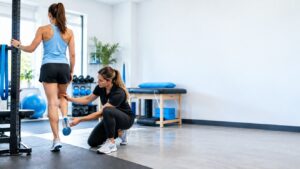
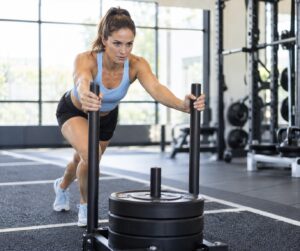
Exercise doesn’t just protect the bone density you have, it can help build new bone, even with an osteoporosis diagnosis. This guide covers the science behind why exercise works (Wolff’s Law, real force-on-bone research), the safety principles that make movement confident instead of scary, and links to every exercise-specific guide from In Motion’s Farmingdale, NY team, from Bear Crawl Pose to Deadlifts to Heel Drops.
Are you hesitating to exercise because of your osteoporosis diagnosis? You’re not alone. Many of our clients initially feel uncertain about which exercises are safe and how to start moving confidently again.
Here’s the good news: groundbreaking research shows that proper exercise not only helps prevent bone loss but can actually build bone density. Yes, you read that right – you can get stronger, even with osteoporosis!
This guide covers the science behind why that’s true, the safety principles that make exercise feel less intimidating, and exactly which exercises we recommend, with links to a full how-to for each one.
The Science Behind Exercise and Bone Health for Osteoporosis
Here’s something that might surprise you: your bones are alive! They’re not just rigid support structures – they’re dynamic, living tissues constantly rebuilding themselves. Think of your bones like a busy construction site where old bone is being removed and new bone is being built every single day.
Wolff’s Law: How Bones Adapt to Load
Ever wonder how bones get stronger? It’s thanks to something called Wolff’s Law: your bones adapt to the forces placed upon them. When you exercise, you’re essentially telling your bones, “Hey, we need to be stronger here and they lay down more bone!”
This might seem counterintuitive – especially if you’re worried about fractures. But here’s what’s actually happening:
- When you apply controlled stress through exercise:
- Your bone cells detect the pressure
- They respond by building more bone
- The bone becomes denser and stronger
- Your body becomes more resilient
- Without enough stress (like when we’re too sedentary):
- Bones don’t get the “build stronger” signal
- Bone loss happens more quickly than bone building
- Density gradually decreases
- Fracture risk increases
The Research Behind the Results
The LIFTMOR trial is the study we point to most often. Postmenopausal women who did supervised, high-intensity resistance training (5 sets of 5 reps, above 85% of their one-rep max, twice a week) saw a 3% increase in spine bone density in just 8 months. The same study found no new vertebral fractures and no worsening of existing ones, and participants reported enjoying it more than a low-intensity control program. It’s never too late to start building stronger bones.
Not every type of movement loads your bones equally. A 2018 biomechanics study measured the actual force different movements put through the skeleton, relative to your body weight:
Movement | Force (relative to body weight) |
Lunge | 1.1x |
Walking | 1.2x |
Marching in Place | 1.5x |
Running | 2.6x |
Step-Up (12″) | 2.7x |
Jumping Take-Off | 3.5x |
Heel Drop | 3.6x |
Jump Squat | 3.8x |
Foot Stomp | 4.6x |
Vertical Jump | 4.7x |
Vertical Squat Jump | 7.1x |
This is exactly why we program specific moves like heel drops into an osteoporosis routine instead of relying on walking alone. Walking is safe and good for you, but it’s putting a fraction of the load through your bones that a heel drop does.
Building Your Exercise Confidence
Most osteoporosis fractures don’t happen during exercise. They happen in three scenarios: during a fall, with combined movements like bending and twisting at the same time (think reaching into the back seat of your car), or from minor forces like a cough or a small bump once bone has become significantly weakened.
A Physical Therapist helps prevent these by strengthening the muscles that support your bones, improving your balance, and teaching you safer movement patterns for daily life, not just in the gym.
The 3-Point Safety Check
Before you move, especially for everyday tasks like picking something up off the floor, think through these three things.
Neutral spine position. Picture a straight line from your ears to your shoulders to your hips. Keep the natural curve of your spine and let your core support the movement, especially when reaching.
Controlled breathing. Holding your breath during exertion (the Valsalva maneuver) has a place in powerlifting, but it creates unsafe pressure on the spine if you have osteoporosis. Breathe steadily and exhale on the effort.
Stable base of support. Reach only within a base you can trust. Falling is the most common cause of fracture for someone with osteoporosis, so an even, steady surface matters more than it seems like it should.
Safe vs. Unsafe Movement Patterns
Generally safe:
- Hip hinging. Sit back through your hips instead of bending forward through your spine. This is why deadlifts are safe for osteoporosis when done correctly, they’re a hip hinge under load.
- Controlled squatting. Keep weight in your heels as you sit back, knees tracking over your toes. Don’t “plop” into the chair behind you.
- Supported balance work. Hold onto a counter or sturdy chair to practice weight shifting and single-leg balance, then progress toward less support as it feels steady.
- Progressive resistance training. Start with a resistance you can control, and increase load only as your form holds up.
Movements to modify or avoid:
- Deep forward bending increases pressure on the vertebrae.
- Rapid twisting creates shear force on the spine.
- High-impact without progression can be more force than your bones are ready to withstand.
- Unsupported forward flexion raises fracture risk in the spine for the same reason as deep forward bending.
The goal isn’t to avoid movement. It’s to move smarter. Once you understand these principles, you can adapt almost any activity to make it safe.
The Exercises We Recommend
We’ve written full how-to guides for the specific exercises that make up a safe, effective osteoporosis routine. Each one covers exact form cues, so start here:
- 5 Best Osteoporosis Exercises: the best starting point if you’re building a routine from scratch
- Bear Pose: a weight-bearing hold that loads your wrists, one of the most common fracture sites, along with your hips and spine
- Heel Drops: one of the highest-impact, lowest-risk moves you can do (3.6x body weight, per the table above)
- Deadlifts: proper hip-hinge loading for your hips and spine
- Spine-specific exercises: if vertebral bone density is your main concern
How Progression Actually Works
Building strength with osteoporosis is a slow climb, not a sprint. You want to be stable at one level before adding load at the next. Here’s a general sense of how that progression tends to look over about three months, though your actual plan should be built around your DEXA results and current ability, not a generic table:
Stage | Focus |
Weeks 1-4 | Foundation: bodyweight movements, balance basics, learning form |
Weeks 5-8 | Adding light resistance: bands, light weights, more balance challenge |
Weeks 9-12 | Progressive loading: heavier resistance, more complex movement patterns |
You’re ready to move to the next stage when you can perform the current exercises with good form, no pain during or after, and the movement starts to feel easier rather than effortful.
Balance: Your Secret Weapon Against Falls
One in four adults over 65 will fall this year. For someone with osteoporosis, a fall carries real consequences, but balance is a skill you can improve at any age.
Balance training isn’t just about avoiding a fall. It’s what lets you walk on uneven ground, take the stairs without gripping the railing white-knuckled, and move confidently through a crowded room.
A typical progression: stand on two feet with your eyes open, then closed. Move to a staggered stance, heel nearly touching toe. Progress to single-leg balance near a counter, then away from it. Finally, add movement: walking heel-to-toe, side-stepping, stepping over objects. Progress to the next level only once the current one feels controlled, not just possible.
Pilates for Osteoporosis
Pilates is a strong fit for osteoporosis when it’s modified correctly, and that “when” matters. Traditional Pilates includes plenty of flexion-based movements (think rolling up through your spine) that aren’t appropriate for someone with low bone density.
Finding a neutral spine is a foundational Pilates principle, and it happens to be exactly what protects your vertebrae from fracture risk. Combined with the slow, controlled nature of Pilates work, it builds the same balance and body awareness that reduces fall risk everywhere else in your life.
At In Motion, our Pilates instruction is led by a Doctor of Physical Therapy, not a generalist instructor, specifically because knowing which traditional exercises to modify or skip (roll-ups, the Hundred, spine twists, and rolling like a ball are common ones we adjust) requires understanding bone health, not just Pilates.
“I Am Very Thankful for My Improved Strength, Balance, and Stamina”
Joan came to us wary of exercise, worried about an upcoming trip to Portugal that would mean 5-6 mile daily walks over hilly, cobblestone terrain. Starting in July, she built a program combining foundational strength work, progressive balance training, and functional movement practice.
“I just returned from a wonderful tour of Portugal with my husband. Most days our guide led our group on 5-6 mile walks in hilly medieval cities. I was able to handle those demands despite being a senior with osteoporosis. I have been receiving physical therapy since July and am very thankful to Laura Sommer & the In Motion team for my improved strength, balance, and stamina.”
Joan, In Motion Physical Therapy patient
Joan didn’t stop once she got back from Portugal. She still trains with our team every other week, because staying strong isn’t a one-time goal, it’s an ongoing one.
Start Your Journey with In Motion PT Today
The goal isn’t to avoid movement – it’s to move smarter. When you understand these principles, you can confidently adapt almost any activity to make it safe and beneficial for your bones.
Why Work with a Physical Therapy Expert?
Any movement is generally good for you. But working with a Doctor of Physical Therapy specifically gives you a few things a generic program can’t:
- Clinical expertise. Understanding of bone health and disease progression, including the ability to read and interpret your DEXA scan and knowledge of how your medications affect exercise response.
- A real assessment. Comprehensive movement analysis, strength testing, balance testing, and identification of your specific risk factors, not a one-size-fits-all starting point.
- Safe progression. Your starting point is based on your current ability, not a guess.
- Hands-on correction. Real-time feedback on form during your actual exercises.
A Doctor of Physical Therapy has completed doctoral-level education and holds state licensure as a healthcare provider, which means they can also communicate directly with your medical team to keep your care coordinated.
Frequently Asked Questions about Osteoporosis
Can exercise really improve my bone density, or just slow the loss?
Is it too late to start if I've never exercised before?
What's the difference between osteoporosis and osteopenia exercise recommendations?
Do I need to avoid all twisting and bending forever?
How is this different from a general senior fitness class?
Ready to Build a Plan That’s Actually Yours?
Every exercise in this guide is a starting point, not a substitute for a plan built around your specific DEXA results, fracture history, and goals. Our Doctors of Physical Therapy build that plan with you.
Call 516-659-1087 or visit our Osteoporosis Physical Therapy page to get started.
Next on Your Reading List:
Serving the Farmingdale, NY community with expert one-on-one care to keep you In Motion.
*Note: This guide provides general information and should not replace professional medical advice. Always consult your healthcare provider before starting any exercise program.*
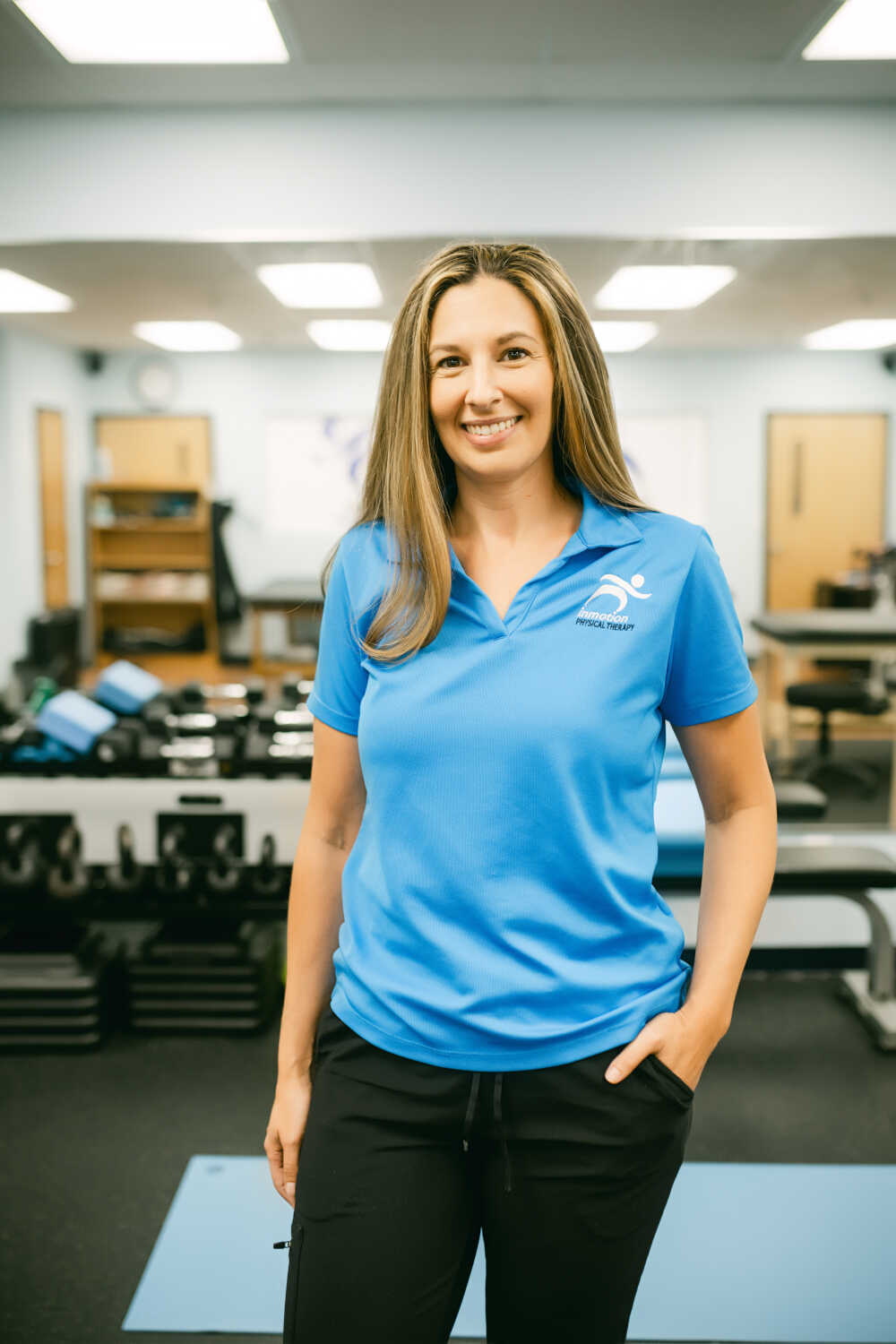
Laura Sommer has been practicing as a Physical Therapist since 2011. She graduated from Northeastern University, where she was a member of the Women’s Soccer Team. Laura is the owner of In Motion Physical Therapy located in Farmingdale, NY.