Bear crawl pose is a simple, weight-bearing exercise done on your hands and knees that’s especially useful for people with osteoporosis, because it loads your wrists, knees, and spine in a neutral, low-risk position. Hold your knees an inch off the mat for 5 seconds at a time, building up reps as you get stronger. This guide breaks down exact form cues, who it’s good for, and how often to do it, straight from the Physical Therapists at In Motion Physical Therapy in Farmingdale, NY.
Bear Crawl Pose for Osteoporosis: A Weight-Bearing Exercise for Stronger Bones
If you’ve been told you have osteoporosis, you’ve probably also been told to do “weight-bearing exercise.” Most people hear that and picture walking or jogging. Bear Crawl Pose is weight-bearing too, just through your hands and knees instead of your feet, which makes it one of the few exercises that loads your wrists and forearms at the same time as your hips and spine.
That matters more than it sounds like it should. Wrist fractures are one of the most common osteoporosis-related breaks, and they’re rarely trained for.
Below, we’ll walk through exactly how to do Bear Crawl Pose safely, who it’s a good fit for, and why loading four points of contact at once is worth the 5 seconds it takes to hold it.
What Bear Crawl Pose Is, and Why It Matters for Osteoporosis
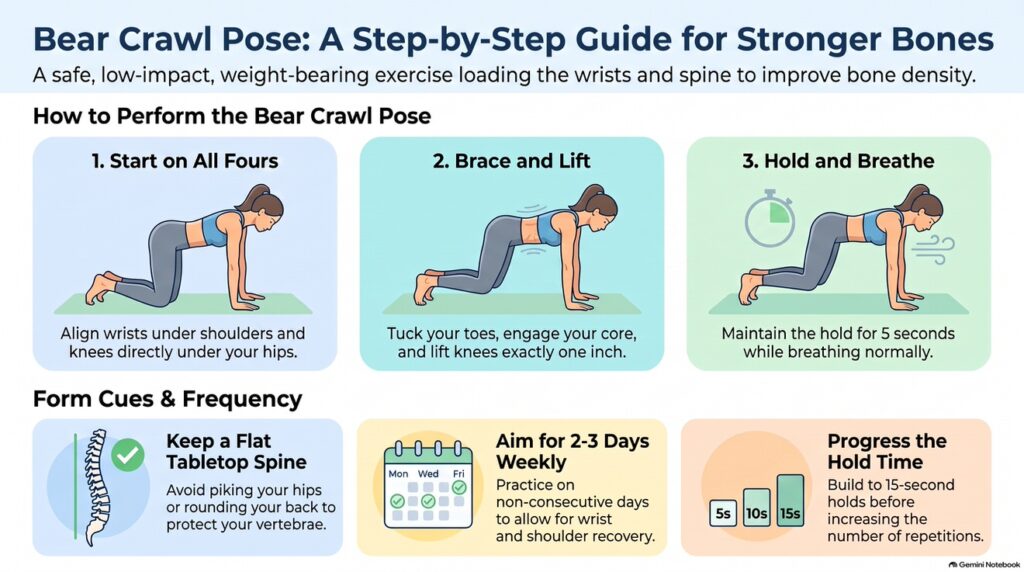
Bear Crawl Pose is a hands-and-knees hold. You come down onto all fours, tuck your toes, brace your core, and lift your knees about an inch off the mat. You hold that position, then set your knees back down.
It looks small. The value is in what it’s doing to your bones while you hold it.
Bone responds to load. When you put weight through a bone, your body reads that as a signal to build more of it, not less. This is sometimes called Wolff’s Law, and it’s the same principle behind why walking helps your hips and spine but does very little for your wrists. The exercises that produce the most bone benefit are the ones that actually load the bone, not just movement in general.
Bear crawl pose is one of the few common exercises that puts real load through your wrists. By bearing weight through your hands regularly, you can build bone in response to the stress. The bear crawl pose is a controlled, low-impact way to do exactly that.
Who Bear Crawl Pose Is Good For
Bear crawl pose is a strong fit if you:
- Have osteoporosis or osteopenia and have been told to add weight-bearing exercise to your routine
- Want to strengthen your wrists specifically, since wrist fractures are one of the most common osteoporosis breaks
- Are comfortable getting down to the floor and back up, or can do so with support nearby
- Have decent core control already, or are working on building it
Check in with your PT or doctor first if you have: a recent wrist fracture or wrist surgery, significant wrist arthritis or carpal tunnel that flares with weight-bearing, a vertebral compression fracture, or balance issues that make getting down to and up from the floor unsafe on your own. None of these rule bear crawl pose out permanently. They just mean it should be introduced with guidance instead of from a video.
One more note, because it comes up a lot with osteoporosis exercise guidance: a lot of floor exercises get flagged as unsafe because they involve spinal flexion (rounding forward), which raises fracture risk at the spine. bear crawl pose isn’t one of them. Your spine stays in a neutral, flat position the entire time. That’s part of why we like it as a starting point.
How to Do Bear Crawl Pose: Step-by-Step
- Start on your knees, then come down onto all fours.
- Set your wrists directly under your shoulders and your knees directly under your hips.
- Curl your toes under so you’re ready to push through your feet.
- Brace your core by drawing your belly button in toward your spine.
- Lift your knees off the mat about an inch. Not higher. This isn’t a plank progression yet, it’s a hold.
- Hold for 5 seconds, breathing normally, then lower your knees back down.
Start with 3-5 holds and build from there.
What Muscles Does Bear Crawl Pose Work?
Bear Crawl Pose asks a lot from your body for something that looks so still. It’s less a “muscle-building” exercise and more a stability exercise, which is exactly why it earns a spot in an osteoporosis routine.
Core. Your transverse abdominis, the deep muscle that wraps around your spine like a corset, along with your obliques, are doing most of the bracing. That’s the “belly button in” cue from the setup, and it’s what keeps your spine neutral instead of sagging or rounding.
Shoulder stabilizers. Holding your wrists under your shoulders doesn’t just load your deltoids, it trains the smaller muscles around your shoulder blades that keep your shoulder joint stable under load. That stability is what protects your shoulders as you progress to harder weight-bearing work later.
Hip stabilizers. Even lifting your knees just an inch, the muscles around your hips are working to keep your pelvis level and your hips from sagging or piking up. That’s the same stability that helps with balance and fall prevention off the mat.
Wrists. This is the one most exercises skip. Holding weight through a flat palm strengthens your wrists directly, which matters because the wrist is one of the most common fracture sites in osteoporosis.
Put together, bear crawl pose isn’t one muscle group working in isolation. It’s your core, shoulders, hips, and wrists all building stability at once, in a single low-impact hold.
How Often to Do Bear Crawl Pose
Two to three times a week is a reasonable starting point, on non-consecutive days so your wrists and shoulders get a chance to recover. As 5 seconds starts to feel easy, you can build the hold to 10-15 seconds before adding reps or sets. Progress the hold time before you progress anything else.
Three Form Mistakes to Watch For
Hips piking up. If your hips lift higher than your shoulders, your core has stopped doing the work and your hip flexors have taken over. Reset so your back stays flat, like a tabletop.
Holding your breath. It’s a natural instinct during a brace, but it spikes blood pressure unnecessarily. Breathe through it.
Lifting too high. An inch is the target, not a guideline you can round up from. Higher isn’t harder in a useful way here. It just changes the exercise into something else.
Frequently Asked Questions About Bear Crawl Pose
Is bear crawl pose safe if I have osteoporosis?
How many times a week should I do bear crawl pose?
What if my wrists hurt during bear crawl pose?
Is bear crawl pose the same as a plank?
Can bear crawl pose actually help prevent fractures?
Not sure if bear crawl pose is right for where you're at?
Next on Your Reading List:
- The Complete Osteoporosis Exercise Guide: Safely Building Confidence and Strength
- Want Unbreakable Bones? Try These 5 Best Osteoporosis Exercises!
- Heel Drops for Osteoporosis: Proper Technique to Build Bone Density
- Why Senior Pilates Classes Are One of the Best Things You Can Do for Your Body After 50
Note: This blog post provides general information and should not be considered a substitute for professional medical advice. If you have any concerns or specific conditions, consult with your healthcare provider before making changes to your recovery routine.
References:
- University of Missouri. Group exercise boosts physical, mental health for older adults. December 2022. https://showme.missouri.edu/2022/group-exercise-boosts-physical-mental-health-for-older-adults-mu-study-finds/
- Bullo V, et al. Effects of Pilates Training on Physiological and Psychological Health Parameters in Healthy Older Adults and in Older Adults With Clinical Conditions Over 55 Years: A Meta-Analytical Review. Frontiers in Neurology. 2021;12:724218. https://pmc.ncbi.nlm.nih.gov/articles/PMC8574969/
- Oliveira LC, et al. The Effectiveness of Pilates Training Interventions on Older Adults’ Balance: A Systematic Review and Meta-Analysis. PubMed Central. 2023. https://www.ncbi.nlm.nih.gov/pmc/articles/PMC10706653/
- Frontiers in Public Health. Impact of physical exercise on health and social interaction in older adults: a meta-analysis. 2025. https://www.frontiersin.org/journals/public-health/articles/10.3389/fpubh.2025.1634313/full
- Turkish Journal of Sports Medicine. Effect of short-term Pilates exercises on bone mineral density and physical performance in older women. 2023. https://journalofsportsmedicine.org/full-text/703/eng
- PMC. Relationship between physical activities and mental health in older people: a bibliometric analysis. https://pmc.ncbi.nlm.nih.gov/articles/PMC11532734/
Laura Sommer has been practicing as a Physical Therapist since 2011. She graduated from Northeastern University, where she was a member of the Women’s Soccer Team. Laura is the owner of In Motion Physical Therapy located in Farmingdale, NY.