“Isn’t she already strong enough from gymnastics?”
I hear this one all the time, and it’s a fair question. Your daughter flips, swings, and sticks landings I could never do. She must be strong.
But being good at gymnastics and being strong enough for gymnastics are not the same thing. I’ve spent about 15 years treating competitive gymnasts, and I’ve learned that skill can hide a lot. When strength training for gymnastics is supervised and progressed appropriately, it can help protect her body and make her skills easier to perform.
Here’s what the research says, what the common worries get wrong, and what a safe program looks like.
Strength Training for Gymnasts: Why Skill Isn’t the Same as Strength
Gymnasts will find a way to get the skill done. That’s what makes them so impressive, and it’s also what makes them hard to read.
I’ll watch a gymnast do something in the gym I couldn’t dream of doing. Then she gets on my treatment table, and I test her quads and hamstrings, watch her landing, and ask her to control a basic movement. And I think: how are you doing what you’re doing?
Skill is technical mastery, built through thousands of repetitions. Capacity is how much force she can produce and absorb, and whether she can do it through a usable range of motion. A gymnast can be off the charts on skill and still have gaps in capacity.
It shows up in small ways. If she can’t get her arms fully overhead, her lower back picks up the difference (here’s why gymnasts are prone to lower back pain). If her ankle doesn’t move well, her landing changes to make up for it. Neither athlete looks weak. They’re borrowing range from somewhere else.
And here’s the part most people miss: the stronger her base, the easier the skills become. Strength isn’t a distraction from skills training. It’s what skills are built on.
Your gymnast’s skills can hide strength gaps that nobody has tested for yet.
What Gymnastics Asks of a Growing Body: Landing Forces and Injury Risk.
Think about gymnastics in four parts: force, repetition, hours, and years.
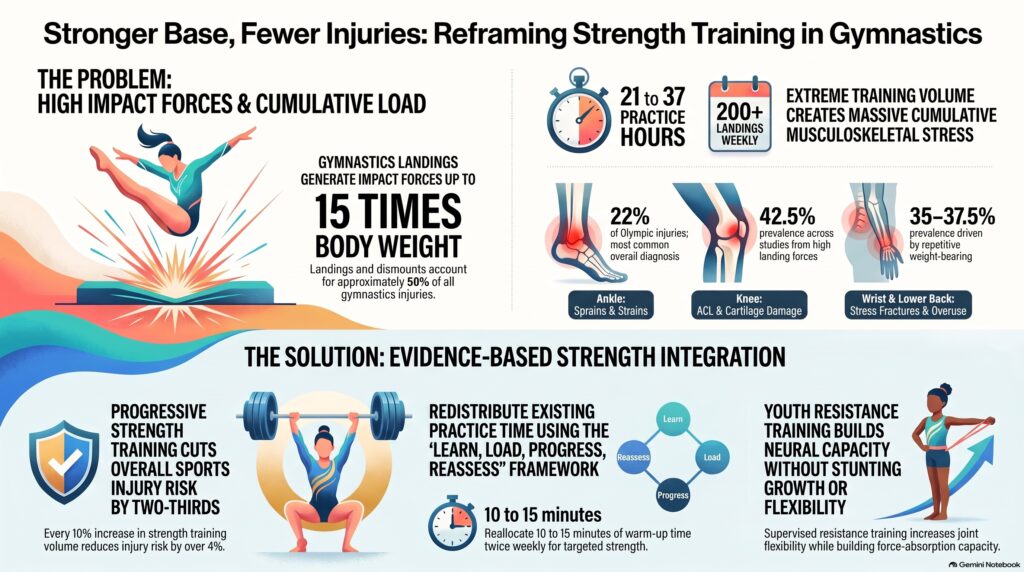
Landings can produce forces of roughly 3 to 15 times bodyweight, depending on the skill, the apparatus, and the drop height. Competitive female gymnasts often train 21 to 37 hours a week, 11 to 12 months a year. Some accumulate more than 200 landings a week. Landings and dismounts account for roughly half of all gymnastics injuries.
(Not sure what to watch for? Here are the five most common gymnast injuries.)
One landing isn’t what worries me. It’s one landing multiplied by hundreds of repetitions, multiplied by weeks, multiplied by years.
So when a parent gets nervous about putting a dumbbell in an athlete’s hands, I ask them to look at what she’s already doing. A light dumbbell is not the first load her body has ever been asked to handle.
What the Research Says About Strength Training for Gymnasts
Three studies matter most to me, and they answer different questions.
It can lower injury risk. A 2018 review in the British Journal of Sports Medicine by Lauersen and colleagues pooled studies of 7,738 athletes. The athletes who did strength training had roughly one third the injury risk of those who didn’t. More strength training meant a bigger drop in risk, for both sudden injuries and overuse injuries. One honest caveat: these were athletes across many sports, not gymnasts only. It’s strong evidence that progressive strength training can reduce injury risk in athletes broadly, but it doesn’t mean lifting cuts gymnastics injuries by two thirds.
It can make gymnasts better. A 2022 study in Medicine & Science in Sports & Exercise followed 43 young female gymnasts who hadn’t yet reached puberty. Some did gymnastics plus strength and neuromuscular training twice a week for ten months. Others did gymnastics only. The strength group improved in force, standing long jump, speed, and vault take-off velocity. So if your gymnast wants a stronger vault, there’s gymnastics-specific evidence for it.
Short, focused warm-up circuits help protect knees and ankles. A 2025 consensus statement in the British Journal of Sports Medicine found that brief strength-based warm-up circuits, around 10 to 15 minutes twice a week, were linked to fewer ACL and ankle injuries in female athletes. This research covers female athletes broadly, not gymnasts specifically.
Strength Training Myths Gymnastics Parents Believe
I hear these worries a lot, and they come from a good place. Here’s what the evidence says.
“She’s already strong enough from gymnastics.” Gymnastics builds skill, grit, and work capacity. It doesn’t systematically build maximum force or load tissue the way progressive resistance does.
“It will stunt her growth.” The American Academy of Pediatrics 2020 clinical report found no negative effect on growth plates or height from well-designed resistance training.
“She’ll get bulky.” Before puberty, most strength gains come from the brain learning to recruit muscle better, not from building size. And I’d ask a different question: what do you want her body to be able to do?
“She’ll lose flexibility.” Strength through a full range of motion does not reduce flexibility. Mobility gives her access to the range. Strength teaches her to own it.
“We don’t have time.” I’m not asking you to add training. I’ll cover that below.
Gymnastics Conditioning vs. Strength Training: Why Hollow Rocks Aren’t Enough
If I asked most gymnastics programs what their strength work looks like, I’d hear hollow rocks, push-ups, rope climbs, circuits, and when that’s not enough, more conditioning.
None of this is bad. It builds work capacity and grit. But it’s high-repetition, bodyweight, fatigue-driven work. It’s a good starting point, but it doesn’t build maximal force the way progressive resistance does.
Bodyweight is a floor, not a ceiling. Here’s how I decide when a gymnast is ready for more:
- She shows good form on a bodyweight squat.
- Her pain with movement is minimal, no higher than 3 out of 10.
- We start with light weight, guided by how hard the set feels (RPE), and build up gradually.
What Safe Strength Training for Gymnastics Looks Like
I use a simple framework: learn, load, progress, reassess.
Learn. She starts with the basic patterns: squat, hinge, push, pull, single-leg work, and trunk control. Bodyweight is fine here, though it isn’t always easier. (For more on the hips, see our guide to gymnastics hip injuries and the best exercises.)
Load. Once she shows real competence, we add resistance, starting light.
Progress. The challenge has to change as she adapts. A gymnast doing three sets of ten of the same thing forever isn’t progressing.
Reassess. Did she actually get stronger? We retest with things like hop testing, heel raises, pull-force testing, and a movement assessment.
A typical session is about 30 minutes, twice a week. It might include step-ups, goblet squats, single-leg bridges, rows, overhead presses, and anti-rotation work. The right program depends on her age, how long she’s been training, her maturity, her injury history, and where she is in her season. A child’s years of coached experience tell me more than her birthdate does.
Redistribute, Don’t Add
Nobody has an extra hour in a gymnast’s week. If I told a gym owner to add more hours, I’d get laughed out of the building.
What I’m asking for is a swap. Take about one hour a week that’s already on the schedule and use it for strength development, in two 30-minute blocks. You don’t need a separate facility. A squat rack, a cable column, dumbbells, and kettlebells are enough. One small group rotates through the strength station while another is on bars or beam.
I work as a partner with the coach. I design the program, teach it, and reassess it. The coach carries it out, practice after practice.
Client Example: Strength Training for a Gymnast With Spondylolysis
A 15-year-old Level 9 gymnast came to us with lower back pain from spondylolysis, a stress injury in the bones of the lower spine. (If your gymnast has been diagnosed, here’s our step-by-step guide to returning to gymnastics after spondylolysis.)
When I tested her, I found she couldn’t use her glutes at all. In a simple glute bridge, she was compensating with her calf muscles. Here was a high-level athlete who could do skills most people can’t, and she couldn’t do a basic bridge the right way.
We built her strength from the ground up: squats, hip hinges, landing practice, and overall strength work. Knowing what I know now, I’d also add Pilates earlier. Dr. Samara Kelhoffer leads Pilates at In Motion, and it’s a great way to build control through the trunk and hips.
She returned to Level 9 gymnastics.
How to Get Started with Strength Training
Questions to ask your gym or clinic: Who designs the strength program, and what’s their training? How do they decide when she moves from bodyweight to added load? How often do they retest?
Signs to get her checked first: pain that doesn’t resolve, repeated ankle sprains, a history of back or wrist pain, or a return from injury.
Frequently Asked Questions about Strength Training for Gymnasts
Is strength training safe for an 11-year-old gymnast?
Will strength training make my daughter bulky?
Should gymnasts lift weights?
How often should gymnasts do strength training?
Will strength training hurt her flexibility?
Ready to Build a Stronger Gymnast?
If your gymnast has nagging pain, a history of injury, or you just want to know whether she’s as strong as her skills make her look, our team can help. Our sports physical therapists have treated competitive gymnasts for years and can assess her strength, movement, and landing mechanics.
If you’re the parent of a gymnast and you’re near Farmingdale, NY, our team at In Motion Physical Therapy would love to help them get stronger with a customized plan. Book an appointment or send us a message through our contact page.
Next on Your Reading List:
- Rise of Gymnast Lower Back Pain: Understanding Causes and Solutions
- 5 Common Gymnast Injuries: Expert Insights for Athletes and Parents
- Gymnastics Hip Injuries and Best Physical Therapy Exercises
- Pilates for Gymnasts: 5 Essential Exercises for Peak Performance
- Returning to Gymnastics After Spondylolysis: A Step-by-Step Guide
Note: This blog post provides general information and should not be considered a substitute for professional medical advice. If you have any concerns or specific conditions, consult with your healthcare provider before making changes to your recovery routine.
References:
- Lauersen JB, Andersen TE, Andersen LB. Strength training as superior, dose-dependent and safe prevention of acute and overuse sports injuries: a systematic review, qualitative analysis and meta-analysis. Br J Sports Med. 2018;52(24). PubMed | Journal page
- Moeskops S, Oliver JL, Read PJ, Haff GG, Myer GD, Lloyd RS. Effects of a 10-month neuromuscular training program on strength, power, speed and vault performance in young female gymnasts. Med Sci Sports Exerc. 2022;54(5):861-871. doi:10.1249/MSS.0000000000002862
- Bullock GS, Räisänen AM, Martin C, et al. Prevention strategies for lower extremity injury: a systematic review and meta-analyses for the FAIR Consensus. Br J Sports Med. 2025;59:1575-1586. doi:10.1136/bjsports-2025-109910
- Stricker PR, Faigenbaum AD, McCambridge TM; AAP Council on Sports Medicine and Fitness. Resistance training for children and adolescents. Pediatrics. 2020;145(6). doi:10.1542/peds.2020-1011
- Brtva P, Bizovská L, Canty B, et al. Modifying landing mat properties elicits different lower limb biomechanical responses in gymnasts and non-gymnasts. Sci Rep. 2025;15:42490. doi:10.1038/s41598-025-26522-y
- Niu W, Feng T, Jiang C, Zhang M. Peak vertical ground reaction force during two-leg landing: a systematic review and mathematical modeling. Biomed Res Int. 2014;2014:126860. doi:10.1155/2014/126860
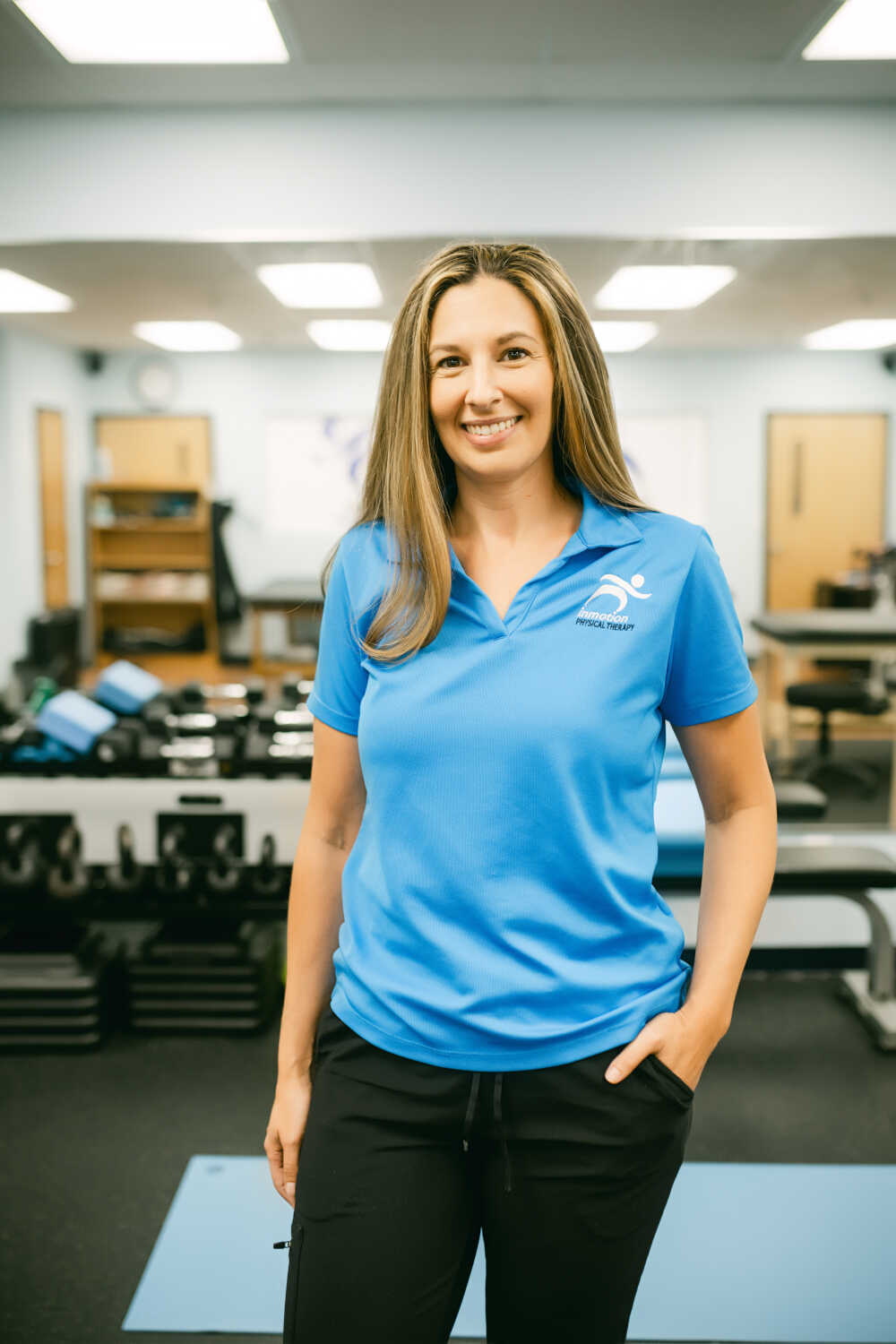
Laura Sommer has been practicing as a Physical Therapist since 2011. She graduated from Northeastern University, where she was a member of the Women’s Soccer Team. Laura is the owner of In Motion Physical Therapy located in Farmingdale, NY.