Return to sport after ACL surgery depends on passing objective testing, not reaching a date. Nine months is the minimum before cutting and pivoting sports, and the strength target climbs from about 80% to start jogging to about 90% for practices, with games as close to equal side to side as possible. This guide covers the tests, the phases, the confidence piece, and what to keep doing after you’re cleared.
Return to Sport After ACL Surgery: 5 Things Athletes and Parents Need to Know
Your surgeon says you’re cleared. Your knee doesn’t hurt, you feel strong, and your teammates are scrimmaging without you. It’s easy to hear “cleared” and think you can go back to everything.
Here’s what we see at In Motion Physical Therapy. Athletes and parents often believe return to sport after ACL surgery comes down to one green light from one appointment. A lot of the time, the surgeon hasn’t seen how you move, and you may not be meeting key benchmarks yet. Six months is just the beginning. There is still more testing to do after it.
This guide is for athletes of all ages and the parents helping them. We’ll cover what the research says, how we test, what the numbers mean, and what to keep working on after you’re cleared.
5 Quick Takeaways
- Surgeon clearance is a first step. Objective testing tells you whether you’re actually ready.
- Nine months is the minimum before cutting and pivoting sports. The calendar alone doesn’t clear you.
- The strength target depends on the activity: about 80% to start jogging, about 90% for jumping, cutting and practices, and close to equal for games.
- Confidence counts as readiness, and it improves with practice.
- Most athletes stall between months 3 and 6, and the work doesn’t end at clearance.

1. The Calendar Is the Minimum, Not the Green Light
Rehab after ACL reconstruction usually takes 9 to 12 months, and good programs move you forward by what you can do, not by what week it is. The calendar tells you the earliest you could be ready. It can’t tell you that you are. Your knee can feel normal long before the graft does. It’s still turning into a living ligament, and that can take up to two years.
Here’s the research behind that. One study followed 106 athletes in pivoting sports for two years. For every month they waited to return, up to 9 months, their reinjury rate dropped by 51%. After 9 months, waiting longer didn’t lower it any further. A separate registry study found that athletes who went back to knee-strenuous sport before 9 months had about 7 times the rate of a second ACL injury. Both are observational studies, so they show a strong link, not proof. They do match what we see in the clinic.
Sports PTs who compared a conservative approach (return at 9 months or later) with an accelerated one (aiming for 6 months) came down in favor of criteria-based rehab. That’s how we work too.
What I wish I’d had
I tore my ACL skiing in 2010. By the time I went back to sport and skiing, my college career was over, so the stakes felt different. My knee has given me no issues in the 16 years since. But I wish I’d had more strength testing and objective data to go on, instead of only a protocol and how I felt. You can read more of my own ACL story here.
For more on the biology behind the timeline, read our ACL healing timeline.
2. The Tests That Decide Return to Sport Readiness
Testing isn’t one big day. We spread it out and test the right things at the right time. We make decisions as we go, and the plan keeps changing based on what we learn.
What we test
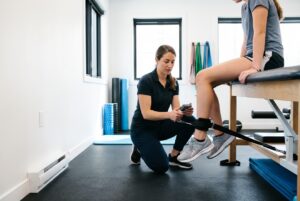
- Strength: We use a Tindeq device to compare your surgical leg with the other leg.
- Rate of force development: This is how quickly you can generate force. Athletes need muscles that turn on fast and adapt. In my opinion, it’s a big missing piece in why some athletes get hurt again after that first injury.
- Hip strength symmetry: Also tested with the Tindeq.
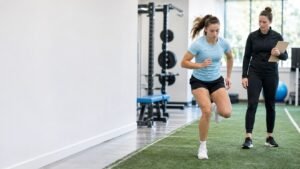
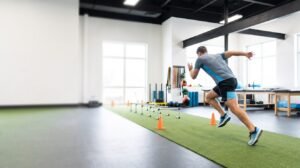
- Hop tests: Single hop, triple hop, cross hop and a timed 6 meter hop.
- Balance and core stability: The Y-Balance Test, where we want less than a 4 cm difference in anterior reach between legs. It also shows us how stable your core is.
- Movement quality: Landing, cutting and sport-specific movement, plus range of motion and swelling.
- Confidence: The ACL Return to Sport Index (ACL-RSI), a short questionnaire about how confident you feel returning to sport, used alongside the physical tests.
None of this is made up on our end. The published ACL rehab guidelines call for the same mix: strength tests, hop tests, movement quality and psychological tests, used together to decide when you’re ready to return.
What the numbers mean
What you’re doing | What we want to see |
|---|---|
Starting to jog | At least 80% quad strength compared with the other leg, plus normal walking, minimal swelling and good control on small landings |
Jumping, cutting drills and practices | About 90% on strength and hop testing |
Games | As close to equal side to side as we can get it, with no pain or swelling and confidence checked |
The published phase guidelines agree. Running starts at 80% or more quad strength. Jumping and sprinting start at 85% or more. Full clearance means 90% or more, no pain or swelling, and a check on fear and confidence.
Matching your other leg isn’t the whole story. That leg can lose strength during rehab, too. When we can find norms for your age and your sport, we compare to those as well. So 90% of the other side may still not be strong enough for what you do.
In one study, of the athletes who failed the return-to-sport criteria, 38.2% reinjured their knee. Of those who passed, 5.6% did. That gap didn’t reach conventional statistical significance, and the study was small. So we treat it as a strong signal, not proof.
If you don’t pass a test
That’s fine. A test result is information, not a grade. It tells us how you’re doing and what still needs work, whether that’s more strengthening, more time in the gym, or more balance work. Then we adjust the plan to what you need.
3. Your Confidence Has to Be Ready Too
Getting back to sport isn’t guaranteed, and the numbers surprise a lot of people. A review of 69 articles covering 7,556 patients found that about 81% returned to some kind of sport, 65% returned to their preinjury level, and only 55% returned to competitive sport. Two things were linked with getting back to the preinjury level: a positive psychological response and symmetrical hopping performance. So confidence and hop testing both belong on the list.
We score confidence with the ACL Return to Sport Index (ACL-RSI) and look at it next to the strength and hop numbers, not instead of them.
Regaining confidence as an athlete doesn’t get talked about enough. Learning to trust your body after an intense injury and a long rehab is mentally hard. But like anything else, confidence comes with practice. The more you practice trusting your leg and doing challenging things, the more it comes back.
My advice to athletes and parents: stay involved with your team in as many things as you can. Teammates can help with the confidence piece when you return.
4. What Each Phase Has to Earn Before You Move On
Each phase has a gate. You move on when you’ve met the criteria, not when the calendar says so.
Phase | Timing | What has to happen first |
|---|---|---|
1. Early | Weeks 0 to 6 | Pain and swelling down, motion restored, quad strength building toward 60% or more |
2. Intermediate | Weeks 7 to 9 | Knee motion 0 to 115 degrees, minimal swelling, normal walking, quad strength 70% or more |
3. Late | Weeks 10 to 16 | Running begins at 80% or more quad strength, with landing mechanics and gym-based strength work |
4. Transitional | Months 4 to 6 | Jumping, sprinting and agility drills at 85% or more on strength and hop testing |
5. Return to sport | Months 6 to 12 | Sport-specific drills and conditioning, with clearance at 90% or more, no pain or swelling, and confidence assessed |
These are general guidelines, not a protocol. A meniscus repair, a revision surgery or your surgeon’s protocol can change the timeline.
Our post on how soon you can run after ACL surgery covers the jogging criteria in detail.
Details for each phase are in our posts on the first week after ACL surgery, 3 months post ACL surgery exercises and torn ACL rehab time. If surgery is still ahead of you, start with prehab.
Where athletes get stuck
Most of my athletes get stuck between months 3 and 6. Honestly, it’s a little boring. You’re past the early pain, but you’re not where you want to be yet. It’s frustrating to watch friends and teammates doing things you’re not ready for.
This is where I see people dip in how consistently they do the work. I get it. It’s monotonous. But we have to do the basics to get to the fun stuff.
5. Cleared Isn’t Finished
Clearance isn’t the finish line. Strength can keep improving up to about two years after surgery.
Speed usually doesn’t come back on its own, so it has to be trained on purpose. We cover that in do you lose speed after ACL surgery.
Both knees need the work. A meta-analysis found a 15% overall rate of a second ACL injury: about 7% in the graft and 8% in the opposite knee. For athletes under 25 who return to sport, it was 23%.
That’s why late rehab includes landing mechanics, strength and balance for both legs.
Female athletes face added risk factors, which we cover in ACL tears in female athletes.
I still do balance and strength work every week, 16 years out. The operated leg still feels a little less stable than the other. Cleared means you’re allowed back. Staying strong is what keeps you there.
Frequently Asked Questions about Return to Sport After ACL Surgery
How long after ACL surgery can you return to sport?
Is 6 months too early to return to sport after ACL surgery?
What tests do you need to pass?
Will I be as fast and strong as before?
How do I know I'm mentally ready?
Not sure you’re ready to go back?
If you’ve hurt your ACL and aren’t sure you’re ready to return to sport, your PT isn’t doing objective testing, or you want a second opinion, come in for an evaluation. If you’re heading into surgery and want to start from the beginning, we’re here for that too.
Call us at 516 659 1087 or send a message through our contact form.
Want the roadmap first?
Download our Athlete’s Complete ACL Recovery Guide It covers what to do before and after surgery, the return-to-sport criteria, and the five biggest recovery mistakes to avoid.
At In Motion Physical Therapy, we work with athletes near Farmingdale, NY, and our whole clinical team competed as athletes. Learn more about our ACL physical therapy.
Next on Your Reading List:
Note: This blog post provides general information and should not be considered a substitute for professional medical advice. If you have any concerns or specific conditions, consult with your healthcare provider before making changes to your recovery routine.
References:
- Grindem H, et al. Simple decision rules can reduce reinjury risk by 84% after ACL reconstruction: the Delaware-Oslo ACL cohort study. Br J Sports Med. 2016;50(13):804-808. https://pubmed.ncbi.nlm.nih.gov/27162233/
- Beischer S, et al. Young athletes who return to sport before 9 months after ACL reconstruction have a rate of new injury 7 times that of those who delay return. J Orthop Sports Phys Ther. 2020;50(2):83-90. https://pubmed.ncbi.nlm.nih.gov/32005095/
- Petterson SC, Buckmire MC, Giordano AO. Recovery stages after anterior cruciate ligament reconstruction. Arthroscopy. 2025;41(11):4393-4395. https://pubmed.ncbi.nlm.nih.gov/41314701/
- van Melick N, et al. Evidence-based clinical practice update: practice guidelines for ACL rehabilitation. Br J Sports Med. 2016;50(24):1506-1515. https://pubmed.ncbi.nlm.nih.gov/27539507/
- Waldron K, et al. Anterior cruciate ligament rehabilitation and return to sport: how fast is too fast? Arthrosc Sports Med Rehabil. 2022;4(1):e175-e179. https://pmc.ncbi.nlm.nih.gov/articles/PMC8811519/
- Ardern CL, et al. Fifty-five per cent return to competitive sport following ACL reconstruction surgery. Br J Sports Med. 2014;48(21):1543-1552. https://doi.org/10.1136/bjsports-2013-093398
- Wiggins AJ, et al. Risk of secondary injury in younger athletes after ACL reconstruction. Am J Sports Med. 2016;44(7):1861-1876. https://pubmed.ncbi.nlm.nih.gov/26772611/
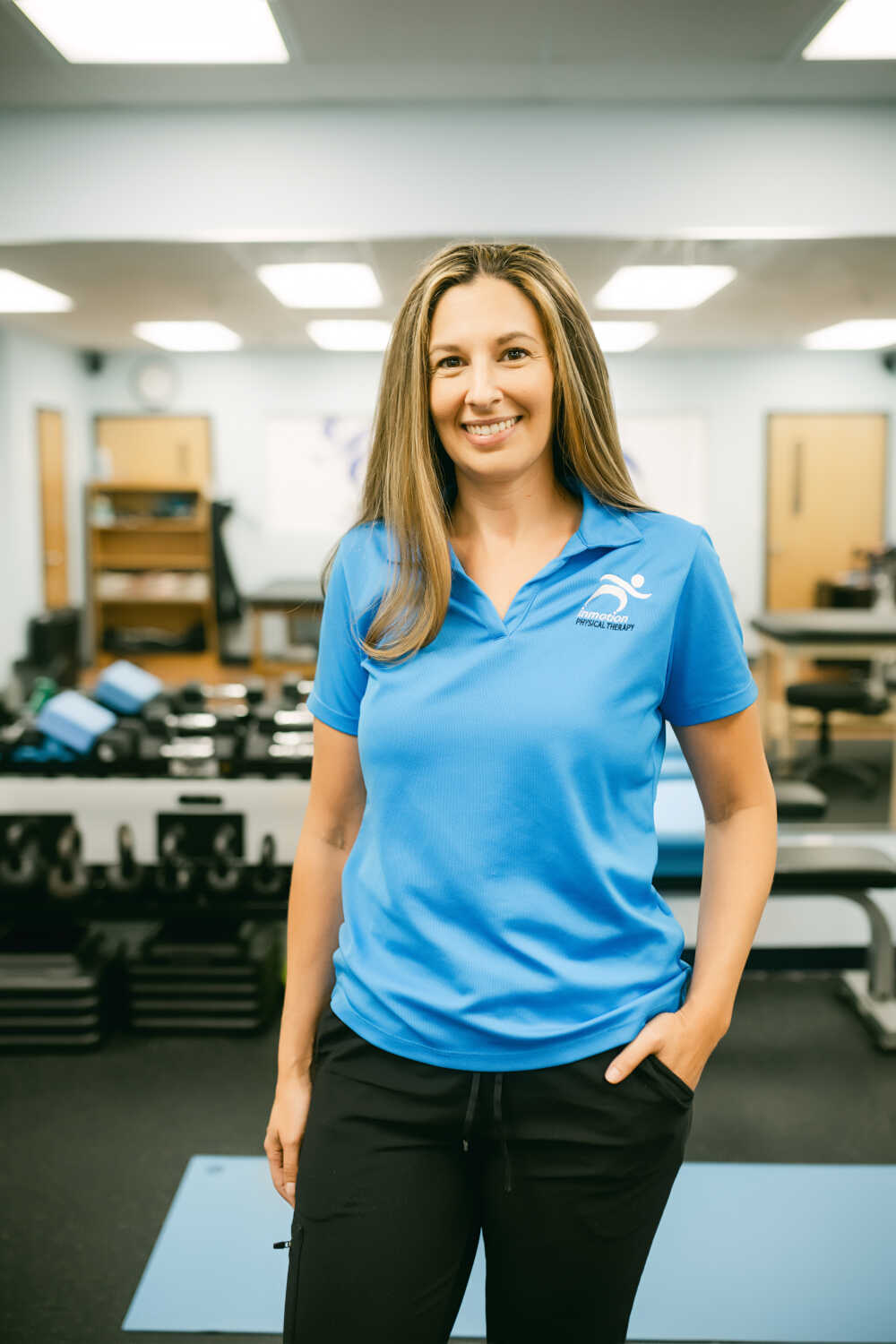
Laura Sommer has been practicing as a Physical Therapist since 2011. She graduated from Northeastern University, where she was a member of the Women’s Soccer Team. Laura is the owner of In Motion Physical Therapy located in Farmingdale, NY.