The first week after ACL surgery sets the tone for your entire recovery. Knowing what to do the first week after ACL surgery, what to wear, how to manage swelling, and when to start physical therapy can make the difference between a smooth return to sport and a slower, more complicated road. This guide gives you a clear, practical week-one plan straight from a sports physical therapist in Farmingdale, NY.
Surgery is done. Your athlete is home. The brace is on, the crutches are in the corner, and someone just asked “so what are we supposed to do now?”
That question is exactly why I wrote this post. The first week after ACL surgery is one of the most important phases of the entire recovery, and it is also one of the least explained. Most families leave the hospital with a prescription for pain medication, a set of crutches, and a follow-up appointment two weeks out. What actually happens in those first seven days is often left to guesswork.
As a sports physical therapist who has worked with gymnasts, cheerleaders, and athletes of all kinds through ACL recovery — and as someone who has been through ACL surgery myself — I can tell you this: week one is not about pushing. It is about protecting the repair, controlling swelling, and waking up the muscles that just went to sleep. Get week one right and every week after gets easier.
What Is Actually Happening in Your Knee Right Now
Your surgeon just reconstructed one of the main stabilizing ligaments in your knee. Depending on the graft type — patellar tendon, hamstring, or donor tissue — the repair is brand new and the first six weeks are a vulnerable period for the graft.
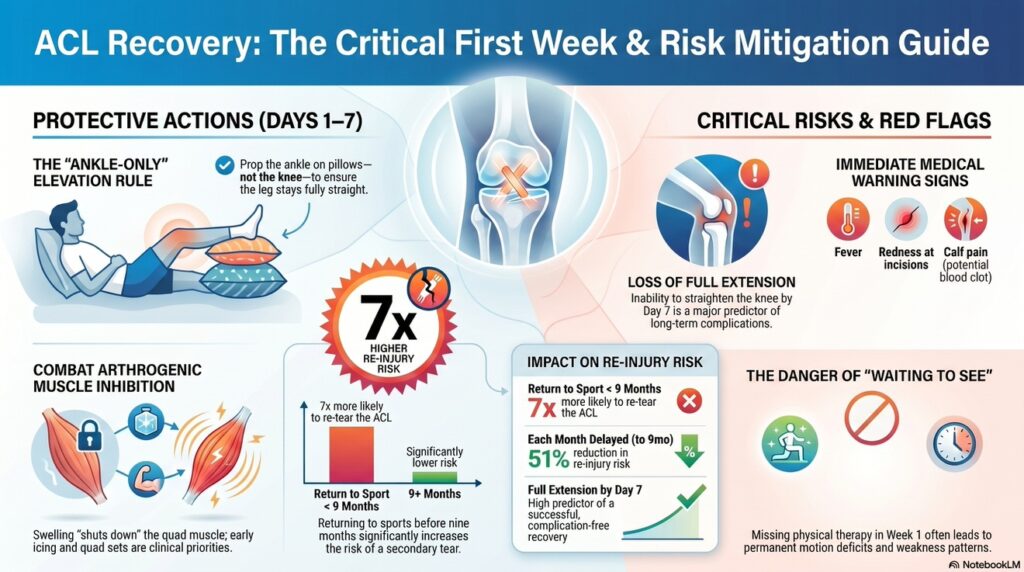
At the same time, your knee is swollen. And that swelling is not just uncomfortable. Fluid in the joint shuts down the quad muscle through a process called arthrogenic muscle inhibition. In plain terms: your quad cannot fire properly when your knee is full of swelling. This is why getting swelling under control in week one is a clinical priority, not just a comfort goal.
The first goal of week one is to get the knee completely straight and get the quad to start turning back on. Everything else builds from there. If you want to understand the full biological process behind graft healing, I break it all down in our ACL Healing Timeline — including what is happening inside the knee at every stage of recovery.
What To Do the First Week After ACL Surgery: Day by Day
Day of Surgery and Day 1
Do not try to be a hero. The anesthesia and pain medication are wearing off and your body just went through something significant. Here is what matters on day one.
Keep the leg elevated above heart level. Place a pillow under your ankle, not under your knee. Putting a pillow under the knee keeps it bent and that works directly against your goal of full extension. Elevate at the ankle so the knee stays straight.
Ice immediately and often. Use an ice pack wrapped in a thin cloth for 15 to 20 minutes at a time, several times per day. A cold water compression device is even more effective if you have access to one.
Keep the brace locked in full extension during all walking. Do not unlock it until your surgeon or PT gives you the green light.
Use your crutches for all walking (unless otherwise instructed). Weight bearing on the surgical leg is usually allowed as tolerated, but THIS DEPENDS ON THE EXACT SURGERY YOU HAD.
Most athletes with only ACL reconstruction are fully off crutches by the end of week two once their quad function comes back enough to walk safely. (this is different is there is meniscus involvement)
Days 2 Through 4: Start Moving the Right Way
This is where most families get surprised. Your surgeon or PT is going to ask your athlete to start gentle exercises almost immediately. This is not aggressive. Early movement is protective. Here is what week-one exercises typically look like.
Quad sets. Lying flat with the leg straight, tighten the quad and press the back of the knee toward the floor. Hold 6 seconds, release. This wakes up the quad without loading the joint at all.
Straight leg raises. With the knee locked straight, lift the entire leg to about 45 degrees and lower it slowly. This is a key early quad exercise that does not stress the repair.
Ankle pumps. Move the foot up and down repeatedly. This keeps circulation moving in the lower leg and helps reduce swelling.
Heel slides. Lying on your back, slowly slide the heel toward the body to gently bend the knee. This begins recovering flexion range of motion.
Patellar mobilizations. Gently move the kneecap side to side. This keeps the joint from stiffening up and reduces tightness around the knee.
None of these are impossible. All of them matter. A physical therapist will walk you through form and dosage at your first visit. For a deeper look at how this connects to the bigger picture, our Physical Therapy for ACL Surgery post explains why starting PT early is the single biggest factor in surgical outcomes.
Days 5 Through 7: Building the Habit
By the end of week one, swelling should be decreasing, pain should be manageable with over-the-counter medication, and your athlete should be completing all of the above exercises with better control. The benchmarks to aim for by day 7 are full knee extension matching the other leg, a straight leg raise with the knee not bending, swelling that is heading in the right direction, and consistent completion of the home program every day.
If full extension is not happening, that needs to be flagged immediately. Loss of extension in the first week is one of the biggest predictors of complications down the road. It is not something to wait and see about.
What To Wear After ACL Surgery With a Straight Leg Brace
This is the question every parent in every cheer and gymnastics group asks right before surgery, and nobody gives a real answer. Here is what actually works.
For bottoms, loose athletic shorts with a wide leg opening are the single easiest option for around the house. They fit over the brace without bunching and you can check brace positioning easily. If you need to go out, zip-off convertible pants are a great solution. You zip off at the knee so you can dress normally on the good leg and slip the shorts portion over the brace on the surgical side. Some athletic brands also make pants with snaps or buttons down the side of the leg specifically for post-op situations. Avoid tight leggings or fitted pants entirely. They are very difficult to get over a locked brace and cause the brace to shift if worn underneath it.
One thing worth knowing: the brace should be worn directly against the skin or over a thin compression stocking, not over pants. Wearing it over clothing causes it to slide down the leg with movement.
For footwear, slip-on shoes or slides on the surgical foot make everything easier. Bending to tie laces is not happening in week one. On the non-surgical foot, keep a supportive sneaker on. Crutch walking puts a lot of demand on that leg and a bare foot or a flip flop is a fall waiting to happen.
For sleeping, lie on your back with the brace on and locked in extension. Put the pillow under the ankle, not the knee. Loose shorts or no bottoms are most comfortable. Avoid sleeping on your stomach, which rotates the surgical leg and strains the healing tissue.
How To Set Up the House After ACL Surgery
A few small changes make a real difference in safety and sanity.
Clear walking paths first. Rugs, cords, pets, and clutter are crutch hazards. Create a clean path between the bedroom, bathroom, and main living area.
Set up one recovery station and make it complete. Pick the spot where your athlete will spend most of the day. Have ice packs, medications, phone charger, water, snacks, and anything else they need all within arm’s reach so they are not getting up and down repeatedly.
Have a plan for stairs. Go up leading with the good leg, go down leading with the surgical leg. Use the railing. Have someone spot for the first several days.
Consider a raised toilet seat or grab bar. Getting up from a low toilet with a straight brace on a swollen knee is genuinely hard. This is a small investment that makes a big daily difference.
Confirm the shower plan with the surgeon. Until incisions are cleared to get wet, a shower chair or keeping the surgical leg outside the tub is the safest approach. Every surgeon has slightly different instructions on timing, so check yours specifically.
When Should I Start Physical Therapy After ACL Surgery?
Honestly, sooner than most people think. Standard rehabilitation guidelines recommend beginning formal PT within one to two weeks of surgery. Some protocols start in the first week.
Early PT is not aggressive. It is supervised. A physical therapist checks that extension (straightening your knee) is on track, makes sure quad activation exercises are being done correctly, monitors swelling, and catches problems before they become complications. Missing those early visits is one of the most common reasons athletes develop motion deficits or weakness patterns that slow down every phase that follows.
One thing I always tell athletes and parents: the work you do before surgery matters just as much as what happens after. A stronger, less swollen knee going into the operating room means a faster, less complicated week one coming out. I have written about this in detail in 5 Things I Wish I Knew Before ACL Surgery — including the fact that I did my own prehab and ran three miles the day before my surgery because I knew it would be a long time before I would run again.
At In Motion Physical Therapy, we like to see ACL patients as early in the first week as the surgeon clears it. That first evaluation sets our baseline and gives us something to build on.
Warning Signs To Watch for in Week One
Most of week one is uncomfortable but normal. These things are not.
Increasing swelling after day 3. Some swelling is expected. Swelling that is getting worse instead of better after the first few days should be reported to the surgeon.
Inability to achieve full extension. If the knee cannot straighten to match the other leg by the end of week one, that needs to be addressed right away. This is a serious early complication.
Fever, or increasing redness and warmth around the incision. These can be signs of infection and warrant a call to the surgeon.
Inability to perform a straight leg raise by day 4 or 5. This suggests significant quad inhibition and needs to be evaluated and treated by a PT.
Calf pain, redness, or significant swelling below the knee. While rare, blood clots can occur after knee surgery. These symptoms need a call to the surgeon same day.
Week One Is Just the Beginning
Week one is about protection and activation. After that the phases build progressively. For a full breakdown of what each phase looks like, our Torn ACL Rehab Time post walks through the complete roadmap from surgery through return to sport. The short version: most athletes are off crutches and beginning to build real strength by weeks two to four, moving into the gym phase by months two to four, and doing sport-specific training from months four to nine.
Current research is clear that returning to cutting and pivoting sports before nine months significantly increases re-injury risk. For every month you delay return to sport up to that nine-month mark, your re-injury risk drops by 51%. Athletes who go back before nine months are seven times more likely to re-tear. That is not a number to ignore. If you are at the three-month mark and wondering what your program should look like right now, our 3 Months Post ACL Surgery Exercises post covers exactly that, including what to prioritize and what to avoid during that vulnerable window.
Getting week one right means your athlete enters every phase ahead of the curve.
Ready to get your athlete started on the right foot?
At In Motion Physical Therapy in Farmingdale, NY, we work with young athletes through every phase of ACL recovery, from day one through return to sport. Call us today and find out how we can help build a plan that gets your athlete back on the field, the mat, or the court.
Frequently Asked Questions About Returning to Gymnastics After Spondylolysis
How much pain is normal in the first week after ACL surgery?
Can my athlete walk without crutches after ACL surgery?
Should the knee be iced constantly after ACL surgery?
When can my athlete return to school after ACL surgery?
How long does ACL recovery take for a young athlete?
Next on your Reading List:
-
ACL Healing Timeline: The Real Roadmap for Returning to Sport
-
Torn ACL Rehab Time: The Honest Roadmap to Returning to Sport
-
The Best 3 Months Post ACL Surgery Exercises for a Safe Return to Sport
-
ACL Tears In Female Athletes: What You Need Know For A Confident Return To Sport
-
5 Things I Wish I Knew Before ACL Surgery: A Physical Therapist's Personal Story
Note: This blog post provides general information and should not be considered a substitute for professional medical advice. If you have any concerns or specific conditions, consult with your healthcare provider before making changes to your recovery routine.
References:
- van Melick N, et al. Evidence-based clinical practice update: practice guidelines for anterior cruciate ligament rehabilitation based on a systematic review and multidisciplinary consensus. British Journal of Sports Medicine. 2016;50(24):1506-1515. https://pubmed.ncbi.nlm.nih.gov/27539507/
- Hunter-Giordano A, et al. ACL reconstruction rehabilitation: clinical data, biologic healing, and criterion-based milestones to inform a return-to-sport guideline. Sports Health. 2022. https://pmc.ncbi.nlm.nih.gov/articles/PMC9460090/
- Filbay SR, Grindem H. Evidence-based recommendations for individuals with anterior cruciate ligament injury. British Journal of Sports Medicine. 2019;53(18):1157-1158.
- Brigham and Women’s Hospital ACL Reconstruction Protocol. 2015. https://www.brighamandwomens.org/assets/BWH/patients-and-families/rehabilitation-services/pdfs/acl-protocol.pdf
Laura Sommer has been practicing as a Physical Therapist since 2011. She graduated from Northeastern University, where she was a member of the Women’s Soccer Team. Laura is the owner of In Motion Physical Therapy located in Farmingdale, NY.