Pilates hasn’t been shown to build bone density on its own, but it does something resistance training doesn’t: it builds the core stability and balance that lowers your risk of the falls that actually cause fractures. This guide covers which traditional Pilates moves to modify or skip if you have osteoporosis, which ones are safe, and why working with a DPT-led instructor matters for this specific population.
Pilates for Osteoporosis: What’s Safe, What to Modify, and Why It’s Still Worth Doing
If you’ve been told to try Pilates for your osteoporosis, you’ve probably also seen conflicting advice about whether it’s actually safe. Some of that caution is fair. Traditional Pilates includes a lot of spinal flexion, the exact movement pattern that raises fracture risk in someone with low bone density. But that doesn’t mean Pilates is off the table. It means it needs to be modified by someone who understands why (like a Doctor of Physical Therapy).
Does Pilates Build Bone Density? Here’s What the Research Actually Says
Let’s start with the honest answer, because we’d rather tell you the truth than oversell it. A 2022 systematic review and meta-analysis in the Journal of Geriatric Physical Therapy looked at Pilates and bone mineral density in postmenopausal women and found no significant effect on BMD at the spine, hip, or femoral neck (de Oliveira et al., 2022). The study pool was small and the quality was mixed, so this isn’t the final word, but right now, Pilates isn’t proven to build bone the way high-intensity resistance and impact training does.
That’s not a reason to skip it. It’s a reason to be accurate about what it’s for.
What Pilates Does Really Well for Osteoporosis
A 2021 meta-analysis of 39 studies in older adults found Pilates had a moderate effect on balance, strength, and functional performance, and a notably large effect on fall risk compared to no exercise at all (Fernández-Rodríguez et al., 2021). That matters more than it might sound like it should: most osteoporosis fractures happen during a fall, not during exercise.
Pilates also centers on finding your neutral spine, which happens to be exactly the position that protects your vertebrae. The slow, controlled nature of the work builds body awareness, the kind that helps you catch your balance instead of losing it when you step off a curb wrong or reach a little too far.
So the honest version: Pilates likely won’t build your bone density on its own. But, it can meaningfully lower your risk of the fall that would break it.
The Problem with Traditional Pilates
Classical Pilates was designed for a general population, not for people managing bone density loss. A lot of the mat repertoire is built around spinal flexion (rounding through your spine), which increases pressure on the vertebrae exactly where you don’t want it.
This is why “just modify as you go” isn’t a safe approach unless the person coaching you actually understands bone health, not just Pilates form.
Pilates Moves We Modify or Skip
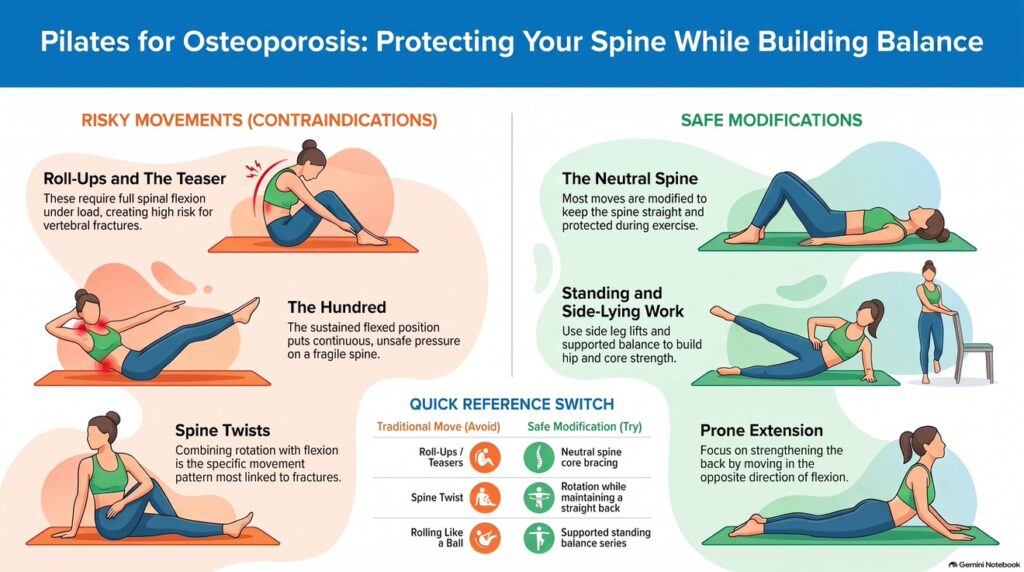
- Roll-Ups: full spinal flexion under load, one of the higher-risk moves in the traditional repertoire
- The Hundred: the flexed starting position puts sustained pressure on the spine
- Spine Twist: combines rotation with flexion, the exact combination linked to vertebral fracture risk
- Rolling Like a Ball: repetitive spinal flexion through a rounded, unsupported spine
- Teaser: demands significant flexion and control that’s rarely appropriate for someone with low bone density
None of these are moves we do with our osteoporosis clients without significant modification, and some we skip entirely depending on your bone density and fracture history.
Safe Pilates Modifications We Use
Standing work. Standing roll-downs modified to stop at neutral spine (not continuing into a full forward fold), side leg lifts for hip strength, standing arm work with resistance, and supported balance work.
Reformer work. Footwork done in neutral spine, modified bridging, standing arm series, and side-lying leg work, all of which load your muscles without asking your spine to flex under resistance.
Mat work. Modified side kicks, prone extension work (the opposite direction of the flexion we’re avoiding), standing balance series, and core work that trains bracing in neutral spine instead of curling forward.
The common thread: every modification keeps your spine in a position that protects it, while still building the strength and balance work that Pilates is genuinely good at.
Why the Instructor Matters More Than the Method
Pilates and osteoporosis can coexist safely, but only when whoever’s coaching you actually knows the difference between a modification that protects you and one that just looks similar to the original exercise.
At In Motion, our Pilates instruction is led by a Doctor of Physical Therapy, not a certified instructor without a clinical background. That’s the difference between someone who can tell you an exercise is “low impact” and someone who understands your specific DEXA results, your fracture history, and how those change what’s actually safe for your spine.
Learn More About Reformer Pilates at In Motion
Frequently Asked Questions About Pilates for Osteoporosis
Is Pilates safe if I have osteoporosis?
Will Pilates increase my bone density?
What's the difference between regular Pilates classes and Pilates with a physical therapist?
Can I still do Reformer Pilates if I have severe osteoporosis?
Ready to Try Pilates the Safe Way?
Call 516-659-1087 or book our New Client Special Online here.
Serving the Farmingdale, NY community with expert one-on-one care to keep you In Motion.
Note: This guide provides general information and should not replace professional medical advice. Always consult your healthcare provider before starting any exercise program.
Next on Your Reading List:
- The Complete Osteoporosis Exercise Guide: Safely Building Confidence and Strength
- Want Unbreakable Bones? Try These 5 Best Osteoporosis Exercises!
- Heel Drops for Osteoporosis: Proper Technique to Build Bone Density
- Why Senior Pilates Classes Are One of the Best Things You Can Do for Your Body After 50
Note: This blog post provides general information and should not be considered a substitute for professional medical advice. If you have any concerns or specific conditions, consult with your healthcare provider before making changes to your recovery routine.
References:
- de Oliveira RG, Anami GEU, Coelho EA, de Oliveira LC. Effects of Pilates Exercise on Bone Mineral Density in Postmenopausal Women: A Systematic Review and Meta-analysis. J Geriatr Phys Ther. 2022 Apr-Jun 01;45(2):107-114. doi: 10.1519/JPT.0000000000000309. PMID: 33967223.
- Fernández-Rodríguez R, Álvarez-Bueno C, Ferri-Morales A, Torres-Costoso A, Pozuelo-Carrascosa DP, Martínez-Vizcaíno V. Pilates improves physical performance and decreases risk of falls in older adults: a systematic review and meta-analysis. Physiotherapy. 2021 Sep;112:163-177. doi: 10.1016/j.physio.2021.05.008. Epub 2021 Jun 7. PMID: 34332493.
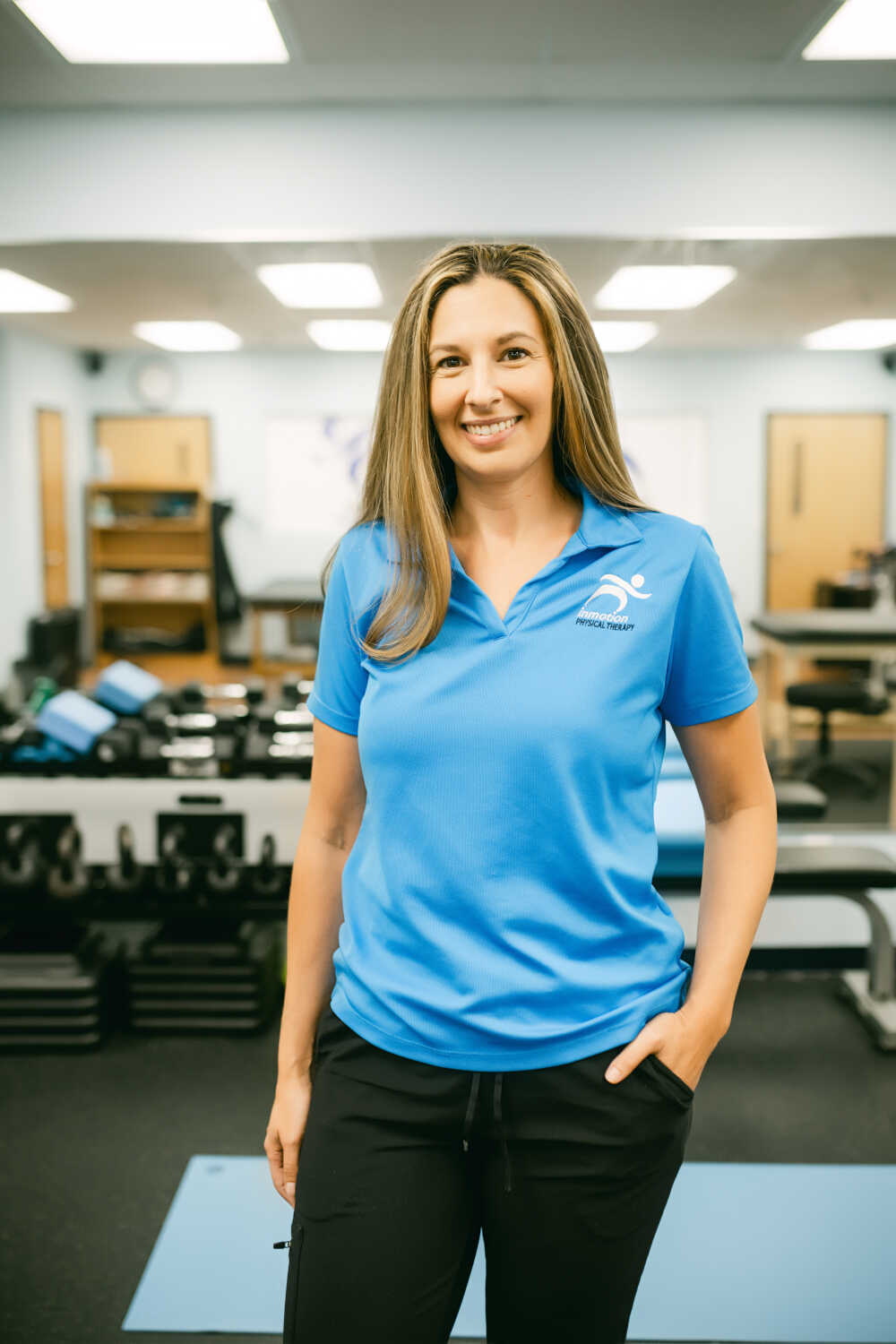
Laura Sommer has been practicing as a Physical Therapist since 2011. She graduated from Northeastern University, where she was a member of the Women’s Soccer Team. Laura is the owner of In Motion Physical Therapy located in Farmingdale, NY.