No, shin splints do not go away the more you run. Running through shin pain keeps loading the same sore spot on your shinbone, and it can turn shin splints into a stress fracture. Most runners recover by cutting back on running for a couple of weeks, cross-training, building strength, and returning to running slowly.
Do shin splints go away the more you run?
I understand why you hope so. I run half marathons myself, and I know how much you want the answer to be yes.
The short answer is no. Running through shin pain keeps loading the same sore spot on your shinbone. That can turn a nagging ache into a stress fracture, and a stress fracture is much harder to come back from.
I’m Dr. Laura Sommer, a sports physical therapist and the founder of In Motion Physical Therapy in Farmingdale, NY. In this post, I’ll explain what shin splints are, why runners get them, what I would do in the first week, and how I bring runners back to the road slowly. If you’re the parent of a young runner, there is a section for you near the end.
Shin Pain that won't settle down?
What Are Shin Splints?
Shin splints is the everyday name for medial tibial stress syndrome, or MTSS. It causes an ache along the inner edge of your shinbone, usually in the lower half of your leg.
Many runners think shin splints are just tight muscles. They are more than that. Every time your foot hits the ground, your shinbone absorbs force. When the pounding adds up faster than your bone can rebuild, the bone gets irritated and sore (1, 2).
That matters because shin splints sit on a spectrum. At one end is a sore, irritated shin. At the other end is a stress fracture, which is a small crack in the bone from repeated stress (4, 5).
Why Do Runners Get Shin Splints?
Shin splints rarely come from one thing. In my experience, it is usually a few things stacking up at once:
- Doing too much, too soon. A big jump in weekly mileage or adding speed work too fast is one of the most common triggers (2, 7).
- Weak hips, calves, or feet. When these muscles are tired or weak, your leg absorbs less of the impact, and your shinbone takes more of it. How your foot rolls in, often called overpronation, can add to the load (7).
- Hard surfaces and worn-out shoes. If your shoes have more than 400 miles on them, have them looked at. Shoes are not the whole story, though. If a pair feels comfortable, I don’t get too picky about brands.
- Not enough fuel, sleep, or recovery. Your body repairs bone with the help of food and rest. If your nutrition, sleep, or stress are off, your bones have a harder time keeping up with your training.
- A past history of shin splints. Runners who have had them before have roughly double the risk in a later season, especially if they come back too soon or never fix the cause (8).
Do Shin Splints Go Away the More You Run?
No. This is the part I most want you to hear.
Here is what usually happens. Your shins hurt at the start of a run. A mile in, the pain fades, and you decide you’re fine. Warming up feels good, and your brain decides things are okay. But your bone is still taking the same pounding with every step.
Then you stop running, and the ache comes back. That is your sign that the pain hasn’t gone anywhere. It just went quiet while you were moving.
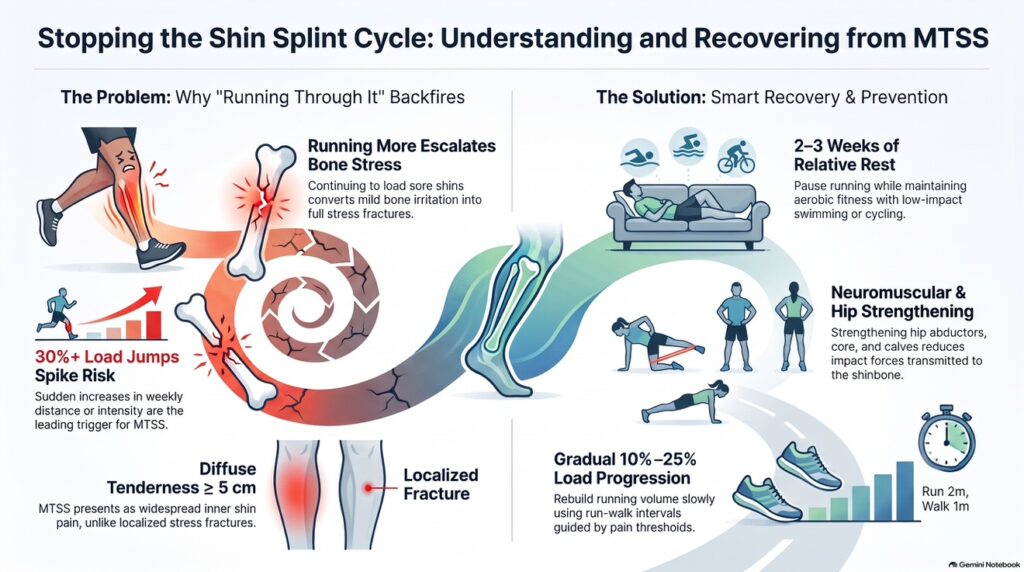
Research backs this up. The most consistent finding across studies is that shin splints improve when you reduce or pause the activity that is causing them, not when you add more of it. A short break of two to three weeks is often enough on its own (1, 3, 6).
Pushing through is risky for another reason. If you keep loading a sore shin, the damage can build up faster than your bone can repair it. That is how shin splints can turn into a tibial stress fracture. Recovery from a stress fracture can take around two months of rest, and some runners need closer to four months to fully return (4, 5).
I have seen runners push through shin splints, think everything was fine, and end up in a boot, not allowed to put weight on that leg. It is very frustrating for them. It is also avoidable.
What To Do in the First Week of Shin Pain
If your shins are sore right now, here is where I would start:
- Cut back your running, but keep moving. Reduce your running, or pause it for a couple of weeks. Swap in the bike, the pool, or deep-water running to keep your fitness up while your shins calm down (3, 6). Getting in the pool is great cardio, and you won’t lose your base as fast as you fear.
- Look at your training log. Check the last three to four weeks. Did your mileage jump? Did you add hills, speed work, or a new surface? Most of the time, the answer is in there.
- Check your hips and calves. Weak muscles that can’t absorb impact are a major piece of the puzzle. This is where a physical therapist can help you find what’s weak. [L2]
- Get checked if the pain doesn’t settle. See the red flags below.
Red Flags: When To Stop Guessing and Get Checked
Some shin pain should not wait. Get evaluated if:
- Your pain sticks around after you stop running, and it starts getting in the way of daily life, like walking or climbing stairs, for more than 48 to 72 hours.
- You can point to one small spot on your shin that hurts to press on, instead of a wider ache (2, 6).
- You have pain at night (2, 6).
- The pain is getting worse even though you have rested (2, 6).
Any of these can point to a stress fracture. Only an exam, and sometimes imaging, can tell you for sure.
How I Test Runners Before They Start Running Again
Feeling better is not the same as being ready. Before I clear a runner to build back up, I want to see that their body can handle the work. Here is some of what I check:
- Dorsiflexion Lunge Test (Knee-to-Wall): 10 cm
- Calf strength. I want to see at least 30 single-leg calf raises without losing any height as you go. Your calf takes on a lot of the load every time you push off.
- Squat quality. Can you squat well, with good control and alignment? Can you do 15 single leg squats?
- Hop tests. These show how well each leg absorbs and produces force. I want to make sure our body is within 90% of the other side.
- Calf, Quad and hamstring strength. Using a tindeq, I compare these to your body weight. I’m looking for 90% side to side, and also % of bodyweight for your age and activity level
- Y Balance Test
This kind of objective testing is part of what we do in return to sport testing at our clinic. It means you come back based on numbers, not just on how you feel.
How To Return to Running After Shin Splints
Once your pain has settled and your strength checks out, the plan is slow on purpose. Here’s how I set it up:
- Start with run-walk intervals. I like to begin with three run days per week.
- Let pain guide you. As long as nothing increases your pain, you can keep progressing. If pain goes above a 4 out of 10, take a step back. At a 7 out of 10, stop and reassess where you are in the plan.
- Keep cross-training. Swimming and biking help your cardio while your legs adapt.
- Keep strength training. We build the muscle that helps your body absorb impact, with a focus on hips, calves, and feet.
- Build volume slowly. Research on runners points to small increases, around 10 to 25 percent, spread over several weeks, not every week (3, 2).
- Check your shoes. If you’ve logged more than 300-400 miles in them, it’s a good time to have them looked at.
This is a general outline. The right pace for you depends on your history, your strength, and your goals, which is why I like to see runners in person.
What I Do When Something Feels Off in My Own Training
I build my mileage slowly, and I still get reminders. Over the last year or so, while I’ve been building back up to half marathons, I’ve had some ankle problems. I didn’t try to run through them.
I cut back my mileage, hopped on the bike more for cardio, and added more strength training. Then I took a hard look at the other pieces: nutrition, sleep, and stress. As a mom of three and a business owner, I’ll be the first to say those buckets are not always dialed in. It’s hard. But they matter, because your body can’t rebuild if you’re running on empty.
If you’re juggling a lot, you’re not alone, and it’s one more reason to give your legs a fair shot at recovery.
A Note for Parents of Young Runners
If your child runs cross country or track, I want you to keep one thing in mind. The biggest risk factor I see in young athletes is not eating and sleeping enough.
Make sure your athlete is fueling well and getting real rest. Coaches and clinicians stay on high alert for RED-S, which stands for relative energy deficiency in sport. It happens when an athlete doesn’t take in enough energy to match their training.
Also watch for changes in mood or friend groups. Some of that is normal teenage stuff, but it can also add to injury risk, so it’s worth paying attention.
If your child has shin pain that lasts, our High School Athlete’s Guide to Preseason Recovery is a good next read.
Do Shin Splints Go Away the More You Run? FAQ
Do shin splints go away on their own?
Can I run with shin splints?
How do I know if it's shin splints or a stress fracture?
Will new shoes fix my shin splints?
How long until I can run again?
Ready To Get Your Shins Back on Track?
Shin pain doesn’t have to end your season. If you’re dealing with shin splints and you’re near Farmingdale, NY, our team at In Motion Physical Therapy would love to help you get back to running with a plan that fits you. Book an appointment or send us a message through our contact page.
Next on Your Reading List:
Note: This blog post provides general information and should not be considered a substitute for professional medical advice. If you have any concerns or specific conditions, consult with your healthcare provider before making changes to your recovery routine.
References:
- Burrus MT, Werner BC, Starman JS, et al. Chronic Leg Pain in Athletes. The American Journal of Sports Medicine. 2015;43(6):1538-47. https://doi.org/10.1177/0363546514545859
- David WB, Sang L, Kumar V, Pandya N. Epidemiology, Work-Up, and Management of Common Track and Field Injuries. Current Reviews in Musculoskeletal Medicine. 2026;19(1):14. https://doi.org/10.1007/s12178-026-10012-3
- Gallo RA, Plakke M, Silvis ML. Common Leg Injuries of Long-Distance Runners. Sports Health. 2012;4(6):485-95. https://doi.org/10.1177/1941738112445871
- Keast M, Bonacci J, Fox A. Acute Effects of Gait Interventions on Tibial Loads During Running: A Systematic Review and Meta-analysis. Sports Medicine. 2022;52(10):2483-2509. https://doi.org/10.1007/s40279-022-01703-1
- Arnold MJ, Moody AL. Common Running Injuries: Evaluation and Management. American Family Physician. 2018;97(8):510-516. https://pubmed.ncbi.nlm.nih.gov/29671490
- Edwards PH, Wright ML, Hartman JF. A Practical Approach for the Differential Diagnosis of Chronic Leg Pain in the Athlete. The American Journal of Sports Medicine. 2005;33(8):1241-9. https://doi.org/10.1177/0363546505278305
- Marques TBT, Rangel RPS, Martins LV, Vidal APC. Preventive Interventions for Medial Tibial Stress Syndrome: Systematic Review and Meta-Analysis. Gait & Posture. 2025;122:92-98. https://pubmed.ncbi.nlm.nih.gov/40633262
- Ohmi T, Aizawa J, Hirohata K, et al. Biomechanical characteristics of the lower extremities during running in male long-distance runners with a history of medial tibial stress syndrome: a case control study. BMC Musculoskeletal Disorders. 2023;24(1):103. https://doi.org/10.1186/s12891-023-06216-0
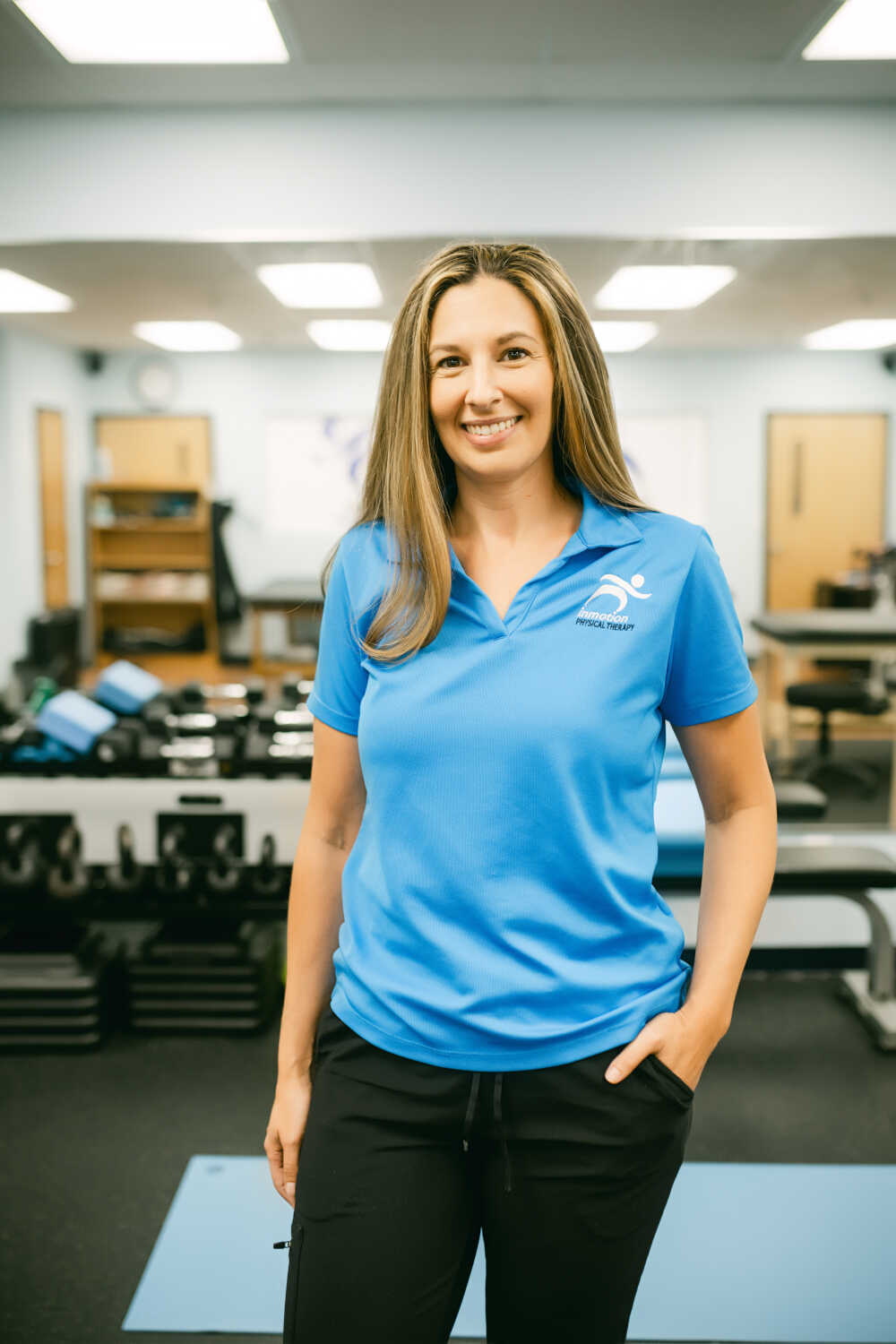
Laura Sommer has been practicing as a Physical Therapist since 2011. She graduated from Northeastern University, where she was a member of the Women’s Soccer Team. Laura is the owner of In Motion Physical Therapy located in Farmingdale, NY.