Somebody said it to your dancer already. Maybe a gym teacher, a coach from another sport, or a well-meaning relative at Thanksgiving: “Irish dance isn’t really a sport, right? It’s just dancing.”
You know better. So does your dancer’s aching shins after a three-hour practice, and so does the research.
Here’s the actual answer: yes, Irish dance is hard on the body — harder than most people realize, and in some very specific ways. Let’s get into what’s actually happening every time your dancer takes the stage.
What Irish Dance Actually Demands From the Body
Picture the mechanics for a second. The upper body stays locked upright with almost no movement, while the legs do something close to sprinting, jumping, and landing, all at once, over and over, for the length of an entire routine.
Add to that: the feet stay pointed down the entire time. Not just during a jump — the whole routine. Every landing happens on the forefoot, not the flat of the foot, which is a much smaller, less stable base to absorb force from. And most of the skills that make a routine impressive (hops, turns, quick direction changes) happen on a single leg.
That combination — rigid trunk, constant plantarflexion, single-leg landings, repeated at high speed for minutes at a time — is a lot to ask of a young, still-developing body.
So, Is Irish Dancing Hard on the Body? The Injury Numbers Say Yes
A 2023 systematic review pulled together the injury data across multiple studies of competitive Irish dancers, and the numbers are hard to argue with.
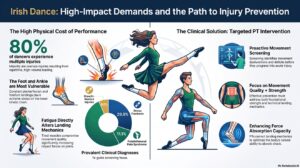
Stress fractures alone account for nearly 30% of all reported injuries — by far the single most common injury type in the sport. Patellofemoral (kneecap) pain comes in second. Growth-related injuries, ankle sprains, and low back issues round out the list.
And here’s the number that should really land: 80% of competitive Irish dancers report being injured more than once. Not “some dancers get hurt.” Most of them, more than once.
Across every study reviewed, one body region shows up at the top again and again: the foot and ankle. That’s not a coincidence — it’s the direct result of a sport that lands its athletes on the forefoot, on one leg, for hours a week.
How It Stacks Up Against Other Sports
If you want a real comparison, Irish dance doesn’t map cleanly onto “dance.” It’s closer to a hybrid of several demanding sports at once.
It has the repetitive jumping of volleyball, the landing mechanics of basketball, the plyometric intensity of gymnastics, the technical precision of ballet, and the lower-extremity loading of figure skating — combined into one sport, performed in hard shoes, on a hard stage.
That’s the honest comparison. Irish dance asks for the athleticism of several different sports and the artistry of a performance discipline, at the same time.
Why So Many Dancers Get Hurt
Roughly 80% of Irish dance injuries are classified as overuse — meaning they build up gradually from repetition, not from one bad landing or fall. That distinction matters, because it means most of these injuries are preventable if they’re caught early.
A few things stack the deck against young dancers in particular:
Most competitive dancers hit their athletic “prime” while they’re still growing — right when growth plates are more vulnerable, coordination is still developing, and muscle tightness from rapid growth is common. That combination raises the risk of bone stress injuries and growth-related pain.
Fatigue is the other piece people underestimate. Tired dancers don’t just feel tired — their mechanics actually change. Jump height drops, landing forces increase, balance gets worse, and reaction time slows down. A fatigued body lands differently than a fresh one, and that difference is exactly where a lot of these injuries start.
What This Means for Your Dancer
Here’s the pattern we see constantly: a dancer has a “minor” ache in the shin or a little ankle stiffness after practice. It doesn’t stop them from dancing, so it gets ignored — until it isn’t minor anymore.
That small thing danced through for a few extra weeks is often the difference between a few sessions of targeted work and months off the stage with a stress fracture. Catching it early is almost always faster, cheaper, and less disruptive to a competition season than waiting.
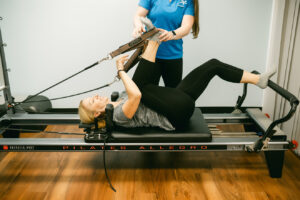
This is exactly where the right physical therapy support changes the trajectory. At In Motion, Samara Kelhoffer brings a perspective built specifically for this: she’s a former competitive gymnast and a certified Pilates instructor, so she understands both the demand of repetitive, high-impact skills and how to build the hip, core, and ankle stability that actually holds up under them.
Strong dancers aren’t just flexible or well-rehearsed — they’re conditioned to absorb force, stabilize on one leg, and recover fast enough to keep training at a high level without breaking down.
Frequently Asked Questions About Irish Dancing Injuries
What's the most common Irish dance injury?
How many hours a week do competitive Irish dancers train?
Can you keep dancing through a stress fracture?
Is Irish dance harder on the body than ballet?
Why don't more people take Irish dance seriously as an athletic sport?
The Bottom Line
Irish dance is hard on the body — genuinely, measurably, and in ways that are specific to how the sport is danced. Your dancer already knows that. Now you have the research to back it up.
If your dancer has nagging pain, a nagging injury history, or you just want a conditioning plan built for the actual demands of Irish dance, that’s exactly what we do at In Motion. Book an evaluation and let’s build a plan that keeps your dancer strong, competitive, and on the stage.
Next on Your Reading List:
Note: This blog post provides general information and should not be considered a substitute for professional medical advice. If you have any concerns or specific conditions, consult with your healthcare provider before making changes to your recovery routine.
Laura Sommer has been practicing as a Physical Therapist since 2011. She graduated from Northeastern University, where she was a member of the Women’s Soccer Team. Laura is the owner of In Motion Physical Therapy located in Farmingdale, NY.