Most athletes return to sport 4 to 5 months after meniscus repair surgery when they follow a structured rehab program. Getting cleared is not just about how your knee feels — your strength, balance, and movement quality all need to be tested and ready. A sports physical therapist can guide you through every stage so you come back stronger and stay in the game.
Return to Sport After Meniscus Repair: What Athletes Need to Know
You just left the surgeon’s office. The procedure went well, the repair held, and someone handed you a sheet of paper with a timeline on it. And all you can think is: when can I actually play again?
That question is the one we hear most from athletes at In Motion Physical Therapy in Farmingdale, NY. Whether you play volleyball, soccer, basketball, or you are a runner or a golfer, a meniscus repair is a significant surgery. The recovery is longer than most athletes expect. And the path back to sport after meniscus repair is not as simple as waiting out a calendar.
This post breaks down exactly what that path looks like — the phases, the real criteria that clear you for competition, and what most athletes get wrong along the way.
First, What Is a Meniscus Repair (and Why Does It Take Longer Than Other Knee Surgeries)?
Your meniscus is the C-shaped piece of cartilage inside your knee that acts as a shock absorber and stabilizer. When it tears, a surgeon can either remove the damaged piece — called a meniscectomy — or stitch it back together, which is called a meniscal repair.
Repair is the preferred option for athletes whenever possible. It preserves the tissue and protects your knee long-term. But there is a tradeoff: healing takes longer.
The reason comes down to blood supply. Parts of the meniscus receive very little blood flow on their own, which means healing is slow. Research suggests the tissue can take up to six months to fully consolidate after surgery. This is not a bone fracture that shows healed on an X-ray. This is tissue that needs time, progressive load, and structured rehab before it can handle the demands of cutting, landing, and pivoting in competition.
Rushing that process is how athletes end up back on the table.
It is also worth knowing that a meniscus tear often happens alongside other knee injuries. If you sustained your tear during a collision or a sudden change of direction, it is worth reading our post on ACL injuries in athletes
The Return to Sport Timeline After Meniscus Repair
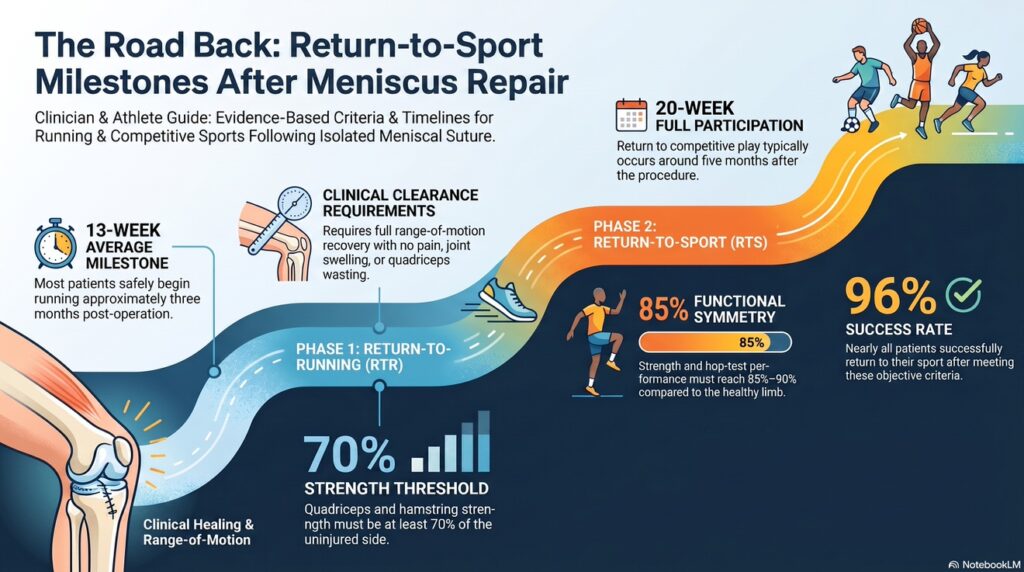
There is no single date that works for every athlete. But research gives us solid averages to work from. A 2023 scoping review published in Orthopaedics and Traumatology: Surgery and Research looked at 20 studies and found that the average time to return to running was about 13 weeks, and the average time to full return to sport was about 20 weeks (Schwach et al., 2023).
Here is what those phases actually look like.
Phase 1: Protect and Heal (Weeks 0 to 6)
The first six weeks are about protecting the repair while the tissue starts to knit together. Your physical therapist will help you manage swelling, restore gentle range of motion, and keep the rest of your body strong without loading the repaired knee.
You can usually bear weight during this phase, but running, pivoting, and deep squatting are off the table. This is a good time to focus on upper body strength, core stability, and non-impact cardiovascular fitness so you are not starting from zero when the knee is ready to load again.
Managing swelling matters more than most athletes realize. Persistent joint effusion — fluid in the knee — shuts down the quad muscle reflexively, which makes strength gains nearly impossible until it is under control. Your PT will check for this at every visit.
Phase 2: Rebuild Strength and Movement (Weeks 6 to 12)
Once the repair is stable, your PT will start reloading the knee progressively. This is when the real work begins. Expect bike work, aquatic therapy, closed chain exercises like step-ups and leg press, and a steady increase in the load placed on the leg.
This phase is where a lot of athletes want to push too fast. The knee often feels good before it is actually strong. Pain-free is not the same as ready.
One tool we use during this phase at In Motion PT is blood flow restriction training. BFR allows us to build significant quad strength at low loads, which makes it ideal for athletes who are still in the early stages of weight-bearing and cannot handle heavy resistance yet. It is one of the most effective tools we have for closing the strength gap between the surgery leg and the healthy leg faster and more safely.
If you skip the strength work in this phase, you will not pass the criteria needed to clear you for running — and you will carry a much higher re-injury risk into the next phase.
Phase 3: Return to Running and Sport Preparation (Weeks 12 to 20)
This is the phase where clearance criteria actually get tested. Your PT will run you through a battery of strength and performance assessments to determine whether your body is ready to handle the demands of your sport. You will begin a progressive running program and start sport-specific movement work including cutting, jumping, and change-of-direction drills.
Clearance to return to sport does not happen at a specific week mark. It happens when you pass the criteria. More on exactly what those are below.
What Actually Clears You for Sport After Meniscus Repair: The 3 Criteria
This is the part most athletes do not fully understand. Getting back to sport after meniscus repair is not about hitting a date on a calendar. It is about meeting three categories of standards: clinical, strength, and performance.
Clinical Criteria: Your Knee Has to Look and Feel Right
Before anything else, your knee needs to pass a hands-on clinical examination. That means:
- Full range of motion, matching your other knee
- No swelling or fluid in the joint
- No pain with daily activity or testing
- No significant quad muscle wasting
These are the baseline requirements. If any one of them is not met, you do not move forward with strength or performance testing. You go back to Phase 2 and keep building. There are no shortcuts here.
Strength Criteria: Your Numbers Have to Hit
This is where athletes most often get surprised. Your leg on the surgery side needs to reach at least 85 to 90 percent of the strength of your healthy leg before you can be cleared for full sport (Schwach et al., 2023). That applies to both your quadriceps and your hamstrings.
At In Motion PT, we measure this objectively using a Tindeq dynamometer. The Tindeq is a handheld strength testing device that captures precise, real-time force data during isometric muscle contractions. We test both quad and hamstring strength and compare the numbers side to side. There is no guessing, no estimating by feel, and no eyeballing how the knee looks during a squat. You either hit the number or you do not.
This matters because the knee can feel strong well before it actually is.
Subjective feedback from an athlete — even a highly trained, high-pain-tolerance athlete — is not enough data to make a safe clearance decision. The Tindeq removes that guesswork entirely and gives us objective data we can track over time to show you exactly how your recovery is progressing.
This same approach applies to athletes recovering from other knee conditions we treat, including patellar tendonitis and Osgood-Schlatter disease, where tracking quad strength symmetry is equally important for safe return to sport.
Performance Criteria: Your Body Control Has to Be Back
Strength in a controlled test is one thing. Moving like an athlete under real conditions is another. The final category of clearance testing looks at how your whole system handles sport-like demands.
At this stage you will complete tests including:
- Single-leg hop test, where your surgery leg needs to reach at least 85 to 90 percent of your other side
- Y Balance Test, with anterior reach within 5 cm of your healthy side
- Cross-over hop test
- Sport-specific movement screening based on the demands of your particular sport
These tests reveal whether your nervous system and your muscles are communicating the way they need to for safe cutting, landing, and pivoting. A lot of athletes pass strength testing but still show subtle deficits on hop tests. That is why both categories matter, and why checking one without the other gives an incomplete picture.
The Thing Nobody Talks About: Mental Readiness
Here is something the research specifically called out as a gap in return-to-sport care.
Only 2 out of 20 studies reviewed by Schwach et al. even addressed fear and apprehension about the knee (Schwach et al., 2023). That is a significant miss, because fear of re-injury is real, it changes the way you move, and it can actually increase your injury risk if it is not addressed directly.
If you have been cleared physically but you are still hesitating on cuts, protecting the leg during practice, or feeling anxious about contact, that is worth talking about with your PT. Mental readiness is part of full return to sport, not a side issue.
We see this frequently in athletes who sustained a knee injury during a high-stakes moment — a championship game, a college recruitment event, a big race. The physical healing happens on schedule. The confidence takes a little longer. That is completely normal. A good sports PT can help you work through it using gradual exposure, confidence-building progressions, and honest conversations about where your head is at.
Being cautious is not weakness. It is information. And it deserves as much attention as your quad strength numbers.
What Happens If You Go Back Too Early?
This section is short because the answer is straightforward: you risk re-tearing the repair.
A re-tear almost always means going back to surgery. Recovery starts over. And the timeline the second time is not shorter.
Beyond re-tear risk, athletes who return before meeting strength and performance criteria tend to compensate. The hip tightens. The opposite knee absorbs more load. The ankle becomes irritated. Injuries begin to stack because one part of the chain was not ready and everything around it started picking up the slack.
The criteria exist for a reason. Meet them first.
How In Motion Physical Therapy Helps Athletes Return to Sport After Meniscus Repair
At In Motion PT in Farmingdale, NY, we use a criteria-based approach to return to sport. That means we are not clearing you because a certain number of weeks have passed. We are clearing you because your numbers are there, your movement quality is there, and your confidence is there.
Here is what that looks like in practice across your full recovery:
We use manual therapy and hands-on techniques to restore range of motion and manage swelling in the early phases. We build strength progressively using exercises matched to exactly where your repair is in the healing process. We use blood flow restriction training to build quad strength earlier in recovery without placing high loads on the healing tissue. We test your strength objectively with the Tindeq dynamometer so every clearance decision is backed by real data. And we run you through sport-specific performance testing before giving you the green light to compete.
We work with high school and collegiate athletes across volleyball, soccer, basketball, and track, as well as adult athletes who want to get back to the sports and activities they love. If you are also using Pilates as part of your injury recovery or off-season training, our Reformer Pilates program works well alongside sports PT for building the deep stability and body awareness that supports long-term knee health.
Frequently Asked Questions About Return to Sport After Meniscus Repair
How long does it take to return to sport after meniscus repair?
Can I run after meniscus repair surgery?
What happens if I return to sport too early after meniscus repair?
Is meniscus repair or meniscectomy better for athletes?
Do I need physical therapy after meniscus repair?
What sports are hardest to return to after meniscus repair?
How do you measure whether my leg is strong enough to return to sport?
Can I do Pilates during my meniscus repair recovery?
Returning to sport after meniscus repair is absolutely achievable with the right plan. At In Motion Physical Therapy in Farmingdale, NY, we guide athletes through every stage of recovery using hands-on care, objective strength testing, and sport-specific performance work
Next on Your Reading List:
-
Sore Knees After Soccer? Why "Just Resting" Isn't the Answer for Competitive Athletes
-
5 Things I Wish I Knew Before ACL Surgery: A Physical Therapist's Personal Story
-
Patellar Tendinitis Treatment: Why Rest Isn’t Working (and what actually does)
-
Blood Flow Restriction Training: How Athletes Get Stronger Without Heavy Weights
Note: This blog post provides general information and should not be considered a substitute for professional medical advice. If you have any concerns or specific conditions, consult with your healthcare provider before making changes to your recovery routine.
References:
Schwach M, Dergham R, Klasan A, Putnis S, Farizon F, Philippot R, Rambaud A, Neri T. Return-to-sport criteria after isolated meniscus suture: Scoping review of the literature. Orthopaedics and Traumatology: Surgery and Research. 2023;109:103604. https://doi.org/10.1016/j.otsr.2023.103604
Laura Sommer has been practicing as a Physical Therapist since 2011. She graduated from Northeastern University, where she was a member of the Women’s Soccer Team. Laura is the owner of In Motion Physical Therapy located in Farmingdale, NY.