Cheerleader injuries — including wrist pain, knee pain, lower back strain, and ankle sprains — are common in competitive and All Star athletes, but chronic pain is not a normal part of the sport. Physical therapy identifies the root cause of a young cheer athlete’s pain, treats the specific tissues involved, and builds the strength and movement patterns she needs to stay in competition. If your cheerleader in Farmingdale, NY is hurting every practice, this post is for you.
→ Book a Discovery Call
Are you a cheerleader on Long Island? Don't settle for generic PT. At In Motion Physical Therapy in Farmingdale, NY, we specialize in getting competitive athletes back to 100%.
She loves cheer. She’s been tumbling since she was eight years old. But lately, she’s coming home from every practice with her wrists wrapped, her knees aching, and her back tight. She’s started talking about dropping down to base. Or worse, not coming back next season.
If this sounds familiar, you’re not alone. This is one of the most common conversations I have with cheer families in my office. And here’s the thing I want you to hear: chronic pain in a cheerleader is a signal. It’s not a stop sign. It means something needs to be addressed, not that cheer is over.
In this post, I’m going to break down why cheerleader injuries happen, what’s actually going on when multiple joints are hurting at once, and – most importantly – what a proper treatment plan looks like so your athlete can stay in the sport she’s worked so hard for.
Cheerleading Is Harder on the Body Than Most People Realize
Let’s start with something cheer families already know but the rest of the world doesn’t: cheerleading is brutal on the body.
We’re talking gymnastics-level tumbling, basket tosses, pyramids, and partner stunts — often on hard gym floors — with a training schedule that never really stops. No real off-season. No true break. Just skill after skill, practice after practice, year-round.
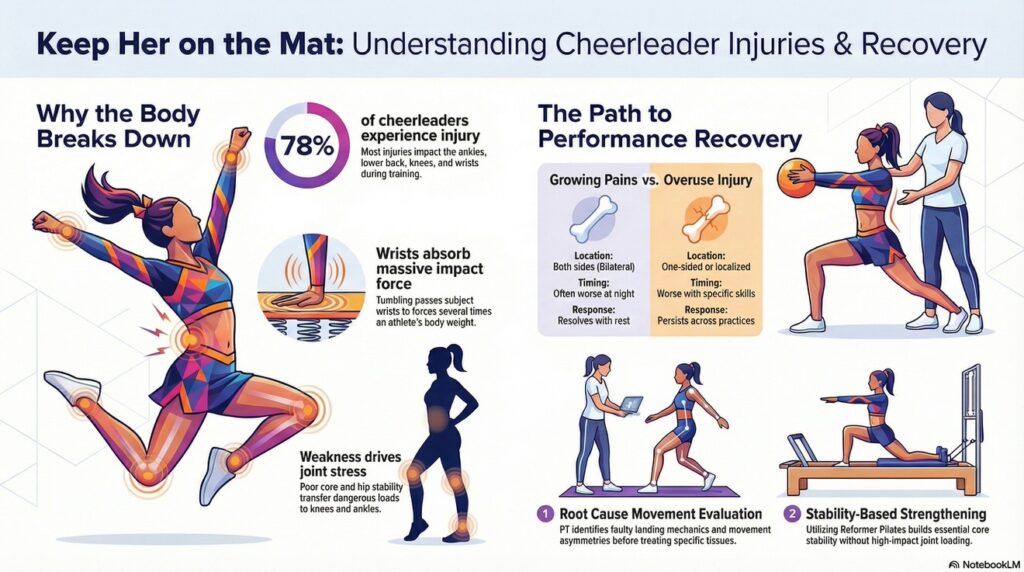
And the numbers back it up. Research shows that the most common cheerleading injuries hit the ankle, lower back, knee, and wrist — mostly during tumbling and stunts. One study even found that during a basic tumbling pass, the wrist absorbs force several times your athlete’s body weight. Think about that. Every back handspring, every round-off, every time she puts her hands on the floor — her wrists are taking a hit most people wouldn’t believe.
Here’s the part that matters most: when your athlete’s body starts breaking down in multiple places at once, it’s not bad luck. It’s a sign that her body is taking on more than it can recover from. That’s not something to push through. That’s something to fix.
Cheerleading Is Harder on the Body Than Most People Realize
Let’s start with something cheer families already know but the rest of the world doesn’t: cheerleading is brutal on the body.
We’re talking gymnastics-level tumbling, basket tosses, pyramids, and partner stunts — often on hard gym floors — with a training schedule that never really stops. No real off-season. No true break. Just skill after skill, practice after practice, year-round.
And the numbers back it up. Research shows that the most common cheerleading injuries hit the ankle, lower back, knee, and wrist — mostly during tumbling and stunts. One study even found that during a basic tumbling pass, the wrist absorbs force several times your athlete’s body weight. Think about that. Every back handspring, every round-off, every time she puts her hands on the floor — her wrists are taking a hit most people wouldn’t believe.
Here’s the part that matters most: when your athlete’s body starts breaking down in multiple places at once, it’s not bad luck. It’s a sign that her body is taking on more than it can recover from. That’s not something to push through. That’s something to fix.
What’s Actually Happening When Multiple Joints Hurt at Once
When a parent tells me their daughter’s wrists, knees, back, and ankles all hurt, the first thing I do is resist the urge to look at each joint in isolation. Because in my experience, when multiple joints are flaring up in a young athlete, it almost always comes back to a few root causes.
Overuse and Insufficient Recovery
A study published in the Journal of Orthopaedic & Sports Physical Therapy found that 78% of cheerleaders experience at least one injury during their athletic career, with the mean time lost per injury being 29 days. In year-round All Star cheer, the tissues never fully recover between training cycles. What feels like “growing pains” is often low-grade overuse that has compounded over weeks or months.
Core and Hip Weakness Driving Joint Stress
The core is the foundation for everything a cheerleader does — every tumbling pass, every jump, every stunt. When a young athlete lacks the core stability and hip strength to control her movement patterns, the load gets transferred downstream to the knees and ankles, and upstream to the lower back. This is one of the main reasons we see multi-joint pain in developing athletes: the joints are paying the price for a weak foundation.
Faulty Landing Mechanics
Research shows that inadequate knee bending during landing significantly increases shear force on the anterior cruciate ligament and overall joint stress at the knee. Landing mechanics are a skill, just like tumbling technique. Poor landings, practiced hundreds of times per week, accumulate into chronic pain over a season.
(Insert landing mechanics youtube video)
Hypermobility Without Adequate Strength
Cheer selects for flexible athletes. But flexibility without strength is a liability, not an asset. Hypermobile joints that lack the muscular support to control their range of motion are far more susceptible to strains, sprains, and chronic overuse. This is especially common in young female athletes whose connective tissue is still maturing.
Growing Pains vs. Overuse Injury: How to Tell the Difference
Not every ache in a young athlete is a red flag. But not every ache is just “growing pains” either. Here’s a quick guide:
- Growing pains: Bilateral (both sides), worse at night, not tied to specific movements, resolve with rest
- Overuse injury: One-sided or localized, worse with specific skills, doesn’t fully resolve with rest, persists across multiple practices
If your athlete’s pain has been present for more than 2-3 weeks, worsens during practice and doesn’t go away after, or is affecting her willingness to perform her skills – that’s not growing pains. That’s a sign that something is being chronically loaded beyond its tolerance, and it needs to be evaluated.
One more thing worth knowing for female cheerleaders specifically. Research shows that cheer athletes are at higher risk for something called Relative Energy Deficiency in Sport, or RED-S. In plain terms, this means the body isn’t getting enough fuel to keep up with the demands of training. Over time, that can weaken bones and increase the risk of stress fractures.
The tricky part is that it often shows up quietly. A little ache here, some vague soreness there. By the time it gets diagnosed, it’s already been a problem for a while. This is exactly why a PT evaluation is about more than just the joint that hurts. We look at the full picture. A generic “just rest” recommendation won’t catch this. We will.
What Physical Therapy Actually Does for a Cheerleader (It’s Not Just Rest and Ice)
This is where I want to be direct with you, because I think there’s a lot of confusion about what PT is and what it isn’t. Physical therapy is not a place you go to do some stretches and wait to feel better. For a competitive cheerleader, it’s a sport-specific performance intervention.
Here’s what the process actually looks like at In Motion Physical Therapy:
1. Full Movement Evaluation
Before we treat anything, we identify why the joints are breaking down. That means looking at landing mechanics, tumbling posture, hip and core strength, joint mobility, and movement symmetry. We’re not just treating the wrist that hurts, we’re finding out why it’s being loaded incorrectly in the first place.
2. Hands-On Manual Therapy and IASTM
For the specific tissues that are irritated — whether that’s the wrist extensors, the patellar tendon, the lumbar fascia, or the ankle ligaments — we use manual therapy and Instrument Assisted Soft Tissue Mobilization (IASTM) to reduce pain, improve tissue quality, and restore mobility. This is not massage. It’s targeted treatment of the specific structures involved.
3. Reformer Pilates for Cheer Athletes
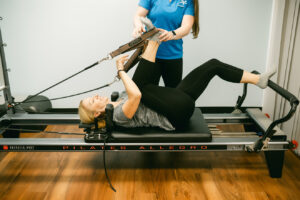
One of the most powerful tools we use for injured cheer athletes is Reformer-based Pilates. The Reformer allows us to build core stability, hip strength, and body control — all the foundational qualities that prevent multi-joint overuse — without the high-impact loading that’s making the joints angry. It’s a way to train hard while the body recovers. Athletes love it because it’s challenging, and it translates directly to the body awareness and stability they need for stunting and tumbling.
4. Marc Pro Electrical Stimulation for Recovery
We also use Marc Pro electrical stimulation for muscle recovery and pain management — particularly useful for athletes who are training through their treatment. Marc Pro enhances the body’s natural recovery process between sessions, helping the muscles clear waste products and stay supple during high-volume training weeks.
5. Sport-Specific Return-to-Skill Progressions
The goal is never just “feel better”. The goal is return to full performance. We build a progressive plan that gradually reintroduces tumbling, stunting, and jumping as tissues heal and strength improves. Research supports staged return-to-sport protocols for reducing reinjury risk, and we work directly with coaches when needed to communicate what skills can be modified and when full participation is safe.
What About Massage, Red Light, Supplements, and Stretching?
I want to address these directly because they come up in every cheer parent community I’ve ever seen online. These tools have value but here’s the honest breakdown:
- Massage: Great for muscle tension and parasympathetic recovery. Works best as a complement to PT, not a substitute. It won’t fix a movement pattern problem.
- Red light therapy: Some evidence for photobiomodulation in tissue recovery. Reasonable adjunct tool. Not a treatment for structural overuse.
- Supplements: Magnesium, vitamin D, and omega-3s support joint and bone health in young athletes — particularly relevant given the bone density concerns in female cheer athletes. Supportive, not curative.
- Stretching: This one is nuanced. For hypermobile cheer athletes, more passive stretching is often exactly the wrong thing. These athletes need stability and strength, not more range of motion. A PT can tell you what kind of flexibility work is appropriate for your athlete specifically.
The common thread: all of these can support recovery, but none of them identify root cause. That’s what PT is for.
What Happens If You Just Push Through It
I understand the impulse. Season is in full swing. Nationals are coming. Dropping a skill or sitting out feels catastrophic for the team. But here’s what the research tells us about athletes who push through chronic pain without addressing it:
- Overuse injuries in skeletally immature athletes don’t resolve on their own, they progress. Stress fractures, tendon degeneration, and ligament laxity all develop on a continuum that starts with the kind of pain this athlete is experiencing right now.
- Pre-competition training fatigue without adequate recovery is a primary driver of serious cheerleading injuries. The body can compensate for a while… until it can’t.
- The psychological toll matters too. Athletes who associate their sport with daily pain eventually quit. Not because of a single injury, but because the grind of chronic discomfort erodes their love for the sport.
The hard truth is this: “pushing through” to stay on the team this season is often the fastest path to being off the team permanently. Early intervention is always the better play.
What To Do Right Now If Your Cheerleader Is in Chronic Pain
Here’s the honest three-step plan:
- Stop guessing. Get a physical therapy evaluation. You need to know what you’re actually dealing with before you throw supplements, massage, or more stretching at it.
- Communicate with the coach. A good PT can help guide which skills to modify temporarily and how to structure practice load to allow recovery without pulling your athlete off the mat entirely.
- Start the process early. Athletes who start PT before an injury becomes severe recover faster and return to full participation sooner. Waiting until she can’t perform is not the strategy.
Frequently Asked Questions About Cheerleader Injuries
Can a cheerleader keep practicing while seeing a physical therapist?
What causes wrist pain in cheerleaders?
Is knee pain normal for cheerleaders?
When should I take my cheerleader to physical therapy?
Can physical therapy prevent cheerleading injuries?
Stop Guessing With Your Arm Care
If your cheerleader is training in Farmingdale, NY or the surrounding Long Island area, we’d love to evaluate her. At In Motion Physical Therapy, we work with competitive athletes at every level — and we know how to keep them in the sport they love while their bodies heal.
Ready to compete your best? Book your Cheerleading Injury Evaluation at In Motion PT today →
Next on your Reading List:
Note: This blog post provides general information and should not be considered a substitute for professional medical advice. If you have any concerns or specific conditions, consult with your healthcare provider before making changes to your recovery routine.
References
- Hardy M, McFaull S, Yanchar NL. Neck and spine injuries in Canadian cheerleaders: an increasing trend. Pediatric Surgery. 2015;50(5):790-2.
- Jacobson BH, Hubbard M, Redus B, et al. An assessment of high school cheerleading: injury distribution, frequency, and associated factors. Journal of Orthopaedic & Sports Physical Therapy.
- Khodaee M, Fetters MD, Shultz SJ, et al. Understanding the cheerleader as an orthopaedic patient: an evidence-based review of the literature. SAGE Open Access / Orthopaedic Journal of Sports Medicine. 2022.
- Shields BJ, Smith GA. Cheerleading-related injuries in the United States: a prospective surveillance study. Journal of Athletic Training. 2009;44(6):567-577.
- Smith R, et al. A systematic review of cheerleading injuries: epidemiological characteristics, biomechanical mechanisms, and prevention strategies. Frontiers in Public Health. 2025.
- Xu AL, Suresh KV, Lee RJ. Progress in cheerleading safety: update on the epidemiology of cheerleading injuries presenting to US emergency departments, 2010-2019. Orthopaedic Journal of Sports Medicine. 2021.
- Currie DW, Fields SK, Patterson MJ, Comstock RD. Cheerleading injuries in United States high schools. Pediatrics. 2016;137(1).
Laura Sommer has been practicing as a Physical Therapist since 2011. She graduated from Northeastern University, where she was a member of the Women’s Soccer Team. Laura is the owner of In Motion Physical Therapy located in Farmingdale, NY.