The typical torn ACL rehab time runs 9 to 12 months — and athletes who return before 9 months are up to 7 times more likely to re-tear their ACL. At In Motion Physical Therapy in Farmingdale, NY, we guide athletes through a 5-phase, criteria-based program focused on biological healing, objective strength benchmarks, and psychological readiness — so you come back for good.
→ Book a Discovery Call
Facing ACL surgery on Long Island? Don't settle for generic PT. At In Motion Physical Therapy in Farmingdale, NY, we specialize in getting competitive athletes back to 100%.
The moment you heard “it’s your ACL,” you probably didn’t ask about the surgery.
You asked: “When can I play again?”
That question makes total sense. Because for a soccer player, a gymnast, a lacrosse or basketball athlete — your sport isn’t just something you do after school. It’s a huge part of who you are.
At In Motion Physical Therapy in Farmingdale, we work with high school athletes every single week who are navigating exactly this. The fear of losing your spot. The pressure of a season slipping by. The frustration of being told to just rest and wait.
So here’s the real torn ACL rehab time — and exactly what it takes to come back stronger than before.
Why 9 Months Is the Magic Number
Here’s the part that catches most athletes off guard.
Around month four or five, you feel great. The knee feels solid. You’re building strength. You’re walking, jogging, maybe even cutting a little.
This is actually one of the most dangerous moments in your entire recovery.
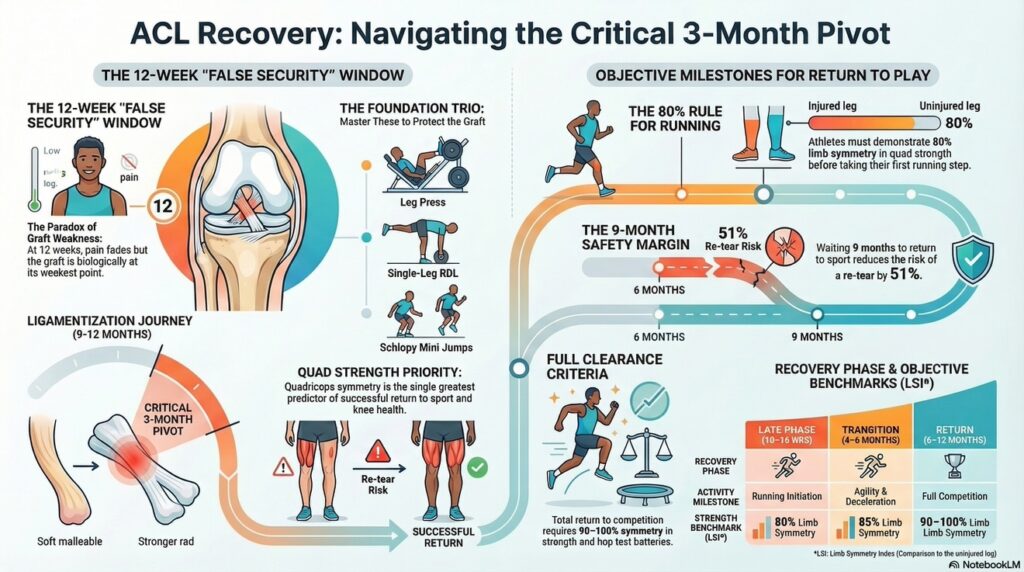
Research in the British Journal of Sports Medicine found that for every month you delay returning to sport — up to 9 months — your re-injury risk drops by 51%. And athletes who go back before 9 months are 7 times more likely to re-tear their ACL.
Seven times.
The reason isn’t fitness. It’s biology.
Your new ACL graft goes through a process called ligamentization. Your body is slowly transforming the transplanted tissue into a real, functioning ligament. It rewires itself from the inside out. You can’t out-train this process. You can’t out-hustle it. It simply takes time.
That’s why we don’t just track how you feel. We track what your body can actually do — with objective testing at every phase.
If you want a deeper look at the biology behind graft healing, we break it all down in our ACL Healing Timeline — including what’s happening inside the knee at each stage of recovery.
The 5 Phases of Torn ACL Rehab Time
The most important shift in ACL rehab over the last decade? Moving away from calendar-based timelines toward criteria-based progressions.
That means you don’t advance to the next phase because it’s been six weeks. You advance because your body has earned it — through objective strength and performance benchmarks.
Here’s how we structure it at In Motion.
Phase 1: Early Post-Op — The “Quiet” Phase (Weeks 0–6)
The first goal is simple: calm the knee down and wake your quad back up.
Surgery creates a lot of trauma. Your leg needs to reduce swelling, get full range of motion back, and begin reactivating the quad muscle — which often “shuts off” after ACL surgery. This is called quad inhibition, and it’s one of the biggest reasons athletes struggle later in recovery.
What we work on: Swelling management, getting range of motion from 0–90° by week one, quad isometrics, and neuromuscular electrical stimulation to retrain the muscle.
We also use Blood Flow Restriction (BFR) training during this phase. BFR lets us build muscle with very light loads — so we’re protecting the graft while still making real strength gains.
What you need to hit to move on: Full knee extension (leg completely straight), minimal swelling, and quad strength at 60% limb symmetry index (LSI). That means your surgical leg is at least 60% as strong as the healthy one.
Phase 2: Intermediate — Strength and Balance (Weeks 7–9)
Here’s something a lot of athletes don’t know.
Between 6 and 12 weeks after surgery, your graft is at its biological weakest. It’s going through the most intense phase of remodeling. But because you feel stronger on the outside, it’s easy to push too hard.
This is a phase that rewards patience.
What we work on: Single-leg balance, proprioception training (rebuilding your knee’s sense of position and control), leg press, step-ups, and neuromuscular coordination.
What you need to hit to move on: Symmetric range of motion in both legs and quad strength at 70% LSI or greater.
Phase 3: Late Post-Op — Impact Introduction (Weeks 10–16)
This is when we start to reintroduce impact — carefully and progressively.
What we work on: Return-to-run progression, landing mechanics training, and building out a gym-based strength program you can own independently.
We also use instrument-assisted soft tissue mobilization (IASTM) — a technique that breaks up scar tissue and keeps the tissue moving freely. Think of it like a targeted deep tissue treatment for the surgical area.
What you need to hit to move on: Quad strength at 80% LSI or greater, with little to no swelling after activity.
Curious about what exercises should look like around the 12-week mark? We put together a full breakdown in our 3 Months Post ACL Surgery Exercises post — including what to prioritize and what to avoid at this stage.
Phase 4: Transitional — Power and Agility (Months 4–6)
Now we train like athletes again.
What we work on: Jumping, sprinting, deceleration drills, cutting, and sport-specific agility. This is also when we formally assess psychological readiness using the ACL Return to Sport after Injury (ACL-RSI) scale.
What you need to hit to move on: Quad strength and hop testing at 85% LSI or greater.
That psychological piece matters more than most people realize. Research shows that about 20% of athletes who don’t return to sport after ACL reconstruction aren’t being held back by physical limitations. They’re being held back by fear.
I know that firsthand.
I tore my own ACL, was misdiagnosed, and didn’t have surgery until almost a year later. By the time I got to recovery, the mental side of it was just as hard as the physical. In my post 5 Things I Wish I Knew Before ACL Surgery, I share what I learned going through it — and what I wish someone had told me before I started.
We don’t treat the mental side as an afterthought here. It’s built into every phase.
Phase 5: Return to Sport — Athlete Mode (Months 6–12+)
This is where regular PT ends and real athletic training begins.
We move off the treatment table and onto the turf. We stop talking about healing and start talking about performance.
What we work on: Sport-specific cutting, pivoting, and full-speed conditioning drills. Getting you back to full pre-injury performance — not just “good enough to play.”
Clearance criteria: Quad strength and hop testing at 90% LSI or greater, ACL-RSI psychological readiness score of 70% or greater, zero pain or swelling.
Here’s a stat that should motivate you to take every phase seriously: only about 55% of athletes return to competitive sport after ACL surgery. A big reason is that people cut corners in the final phases when they feel fine.
Our job is to make sure you’re in the 55% — and that you stay there.
Does Prehab Actually Shorten Your Torn ACL Rehab Time?
Short answer: yes.
Athletes who do 4 to 6 weeks of pre-surgical PT tend to start recovery stronger and hit early milestones faster. Getting your quad firing, your range of motion dialed in, and your swelling down before surgery gives you a real measurable head start.
We put together a full breakdown of the case for prehab — and exactly what to do — in our Key To ACL Success guide.
If you have 3 to 6 weeks before your scheduled surgery date, reach out. That window is more valuable than most people realize.
ACL Rehab in Farmingdale, NY — What Makes Athlete-Specific Care Different
Most PT clinics treat every patient the same — ACL surgery, hip replacement, balance issues — all in the same room, under the same general protocol.
That’s not how we do it here.
At In Motion Physical Therapy, your sport matters. We understand what it means to have tryouts coming up. We know the pressure of a college scout watching your next season. We get the very real fear of losing a starting spot you worked years to earn.
That’s who we built this program for.
Our ACL program includes criteria-based phase progressions, BFR training to protect the graft while building muscle, scar tissue management, Marc Pro electrical stimulation to support muscle recovery, psychological readiness testing, and full sport-specific clearance testing before you go back to competition.
One more thing worth noting: female athletes face different ACL injury risks and recovery patterns than male athletes. If that’s relevant for you or your athlete, our post on ACL Tears in Female Athletes covers what the research says and what it means for your rehab.
Frequently Asked Questions about Torn ACL Rehab Time
How long does torn ACL rehab take for a high school athlete?
Can I do physical therapy before ACL surgery?
What happens if I return to sport too early after ACL surgery?
What is ligamentization?
How do I know I'm actually ready to return to my sport?
Ready to Start Your ACL Comeback in Farmingdale, NY?
ACL recovery is hard. There’s no sugarcoating that.
But the athletes who come back stronger — and stay back — are the ones who took every phase seriously, worked with a team that understood them as competitors, and didn’t rush the process.
If you’re on Long Island and you want care that’s built around your sport, your timeline, and your goals, we’d love to talk.
Submit a Contact Form Here or call our office to schedule your evaluation.
Next on your Reading List:
References
- Grindem H, et al. Simple decision rules can reduce reinjury risk by 84% after ACL reconstruction. Br J Sports Med. 2016;50(13):804–808.
- Beischer S, et al. Young athletes who return to sport before 9 months after ACL reconstruction have a rate of new injury 7 times that of those who delay return. J Orthop Sports Phys Ther. 2020;50(2):83–90.
- Waldron K, et al. ACL Rehabilitation and Return to Sport: How Fast Is Too Fast? Arthroscopy, Sports Medicine, and Rehabilitation. 2022;4(1):e175–e179.
- van Melick N, et al. Evidence-based clinical practice update: practice guidelines for ACL rehabilitation. Br J Sports Med. 2016;50:1506–1515.
- Petterson SC, et al. Recovery Stages After ACL Reconstruction. Arthroscopy. 2025;41(11):4393–4395.
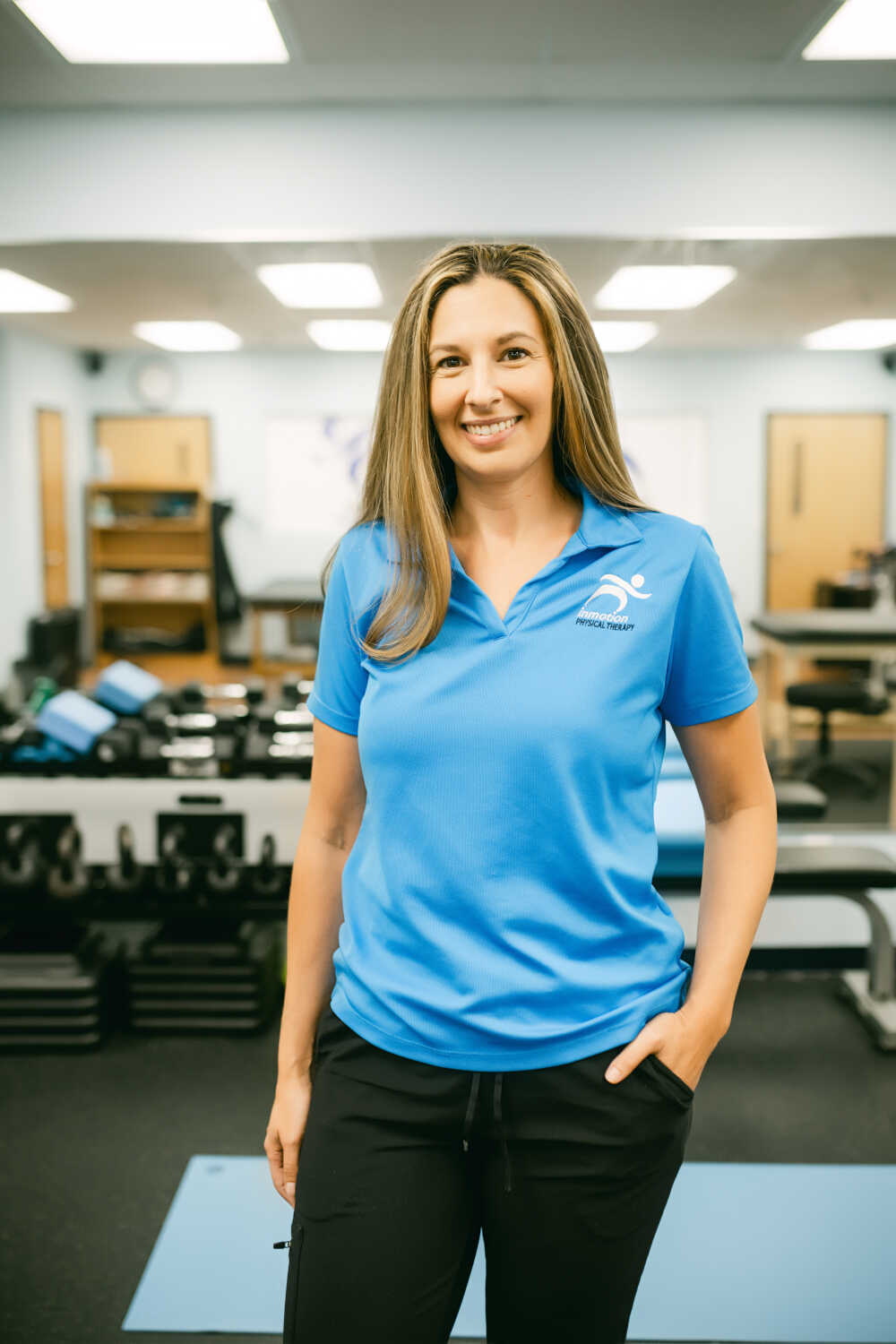
Laura Sommer has been practicing as a Physical Therapist since 2011. She graduated from Northeastern University, where she was a member of the Women’s Soccer Team. Laura is the owner of In Motion Physical Therapy located in Farmingdale, NY.