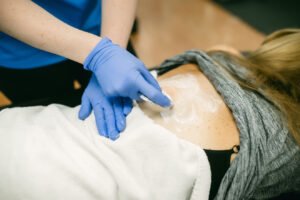
Intercostal muscle strain treatment includes rest, ice, targeted stretching, diaphragmatic breathing, manual therapy, and progressive core strengthening. Recovery typically takes a few days to several weeks depending on severity. Athletes in Farmingdale, NY can work with a sports physical therapist at In Motion Physical Therapy to heal faster and prevent re-injury.
You took a big swing, got checked hard into the boards, or pushed through an extra set of rotational throws—and now every breath feels like a reminder that something’s wrong. Sharp, achy pain wrapping around your rib cage. You try to take a deep breath and wince. You Google it at 11pm and land here.
Good. Because you’re not going to find “just rest and wait” advice on this page.
If you’re dealing with a rib muscle injury and wondering how to actually treat it—and more importantly, how to get back to your sport—this post breaks it all down.
What Is an Intercostal Muscle Strain?
The intercostal muscles are the small but important muscles that live between your ribs. They help your rib cage expand and contract every time you breathe, rotate, throw, swing, or brace for contact.
When one of these muscles gets overstretched or torn—from a hard hit, a powerful twist, or even a violent cough—you have what’s called an intercostal muscle strain. And because these muscles are involved in literally every breath you take, even a minor strain can feel significant.
Common symptoms include:
- Sharp or aching pain along the side of your rib cage
- Pain that worsens when you breathe deeply, cough, or sneeze
- Tenderness when you press on the area between your ribs
- Tightness or a “squeezing” sensation around your chest
- Pain with rotation—the exact movement most athletes need to perform
Strains are typically graded from mild (Grade 1, a few muscle fibers) to more significant (Grade 2-3, with more tearing and longer recovery).
Can I Play Through the Pain?
We get it. The last thing you want to hear is that you need to sit out. But here’s the honest answer: it depends on the grade of the strain, the demands of the sport that you play, and pushing through without knowing can make it worse.
A mild Grade 1 strain might allow modified training within a few days. A more significant tear that hasn’t been properly evaluated? Competing through that can turn a 1-week setback into a 4-6 week one.
The smarter play: get assessed, understand what you’re working with, and follow a plan that keeps you as active as safely possible while the tissue heals. Doing nothing isn’t the answer either—which brings us to treatment.
Intercostal Muscle Strain Treatment: Home vs. With a Pro
Step 1: RICE in the First 24-72 Hours
In the acute phase, the classic Rest, Ice, Compression, Elevation protocol is your starting point. Research from Osmosis (Guo et al., 2025) confirms that rest and ice are the most effective first-line treatments for stopping pain and swelling. Minimal strains often resolve within a few days using this approach alone.
Practically speaking:
- Ice the area for 15-20 minutes every 2-3 hours in the first 48 hours
- Avoid any movements that sharply increase pain
- Modified rest—not complete inactivity—is the goal
Step 2: Breathe Better (Yes, This Is Treatment)
This might sound too simple, but belly breathing—also called diaphragmatic breathing—is one of the most evidence-backed tools for intercostal recovery. Research from the Journal of the Korean Society of Physical Medicine (Koo et al., 2024) found that diaphragmatic breathing reduces muscle stiffness and improves flexibility more effectively than shallow chest breathing.
Most athletes default to chest breathing, especially when in pain. But shallow breathing keeps the intercostal muscles locked up and slows healing.
Try this: Place one hand on your belly and one on your chest. Inhale so your belly rises first. Hold 2-3 seconds. Exhale slowly. Repeat for 5 minutes, 2-3 times per day.
Step 3: Targeted Stretching
Once the acute phase settles (typically 48-72 hours), gentle stretching helps the rib muscles relax and restore mobility. A 2022 study published in Current Research in Physiology (Yokoyama et al.) found that just five minutes of targeted intercostal stretching significantly reduced stiffness and improved chest expansion—which directly translates to better breathing during exercise.
A simple stretch to try: Stand tall, raise one arm overhead, and gently lean away from the injured side. Hold 20-30 seconds. Never push into sharp pain.
Step 4: Manual Therapy From a Pro
This is where working with a sports physical therapist makes a real difference. Hands-on techniques—including soft tissue work, gentle rib mobilization, and a technique called “rib springing”—help restore normal rib cage movement mechanics so the strained muscles aren’t overloaded as they heal (Rumball et al., Sports Medicine, 2005).
Think of it this way: if the ribs aren’t moving freely, the surrounding muscles have to compensate. Manual therapy removes that compensatory stress so healing can actually happen.
At In Motion Physical Therapy, we also use advanced tools like IASTM (Instrument Assisted Soft Tissue Mobilization) and Marc Pro electrical stimulation to accelerate tissue recovery and reduce pain—without slowing down your return-to-sport timeline.
Step 5: Progressive Core and Lateral Trunk Strengthening
Here’s the part most athletes skip—and the reason intercostal strains come back.
Your deep core muscles act as a natural brace for your rib cage. When they’re strong, your ribs are protected. When they’re weak, your intercostal muscles absorb force they were never designed to handle. Research from Rumball et al. (2005) and Vasenina et al. (Sports (Basel), 2022) confirms that core and lateral trunk strengthening is essential for both recovery and long-term prevention of rib injuries.
Exercises like planks, Pilates-based core work, and side-plank progressions target the deep abdominals and obliques—the muscles that sit right alongside your rib cage and act as a shock absorber during high-load athletic movements.
This is where our Pilates-based rehab approach at In Motion shines. Rather than generic physical therapy exercises, we use targeted movement progressions that build the exact muscle endurance competitive athletes need.
How Long Until I’m Back on the Field?
Here’s the realistic breakdown most athletes are searching for:
- Grade 1 (mild): 3-7 days with proper management
- Grade 2 (moderate): 2-4 weeks, depending on sport demands
- Grade 3 (severe): 4-8+ weeks, with structured rehab
The timeline shortens significantly when you start proper treatment early—and lengthens when athletes try to push through and re-aggravate the injury. Early manual therapy, breathing retraining, and progressive loading have been shown to reduce recovery time compared to passive rest alone.
Sport-specific factors matter too. A swimmer rotating every stroke faces different demands than a basketball player. A sports physical therapist will build your return-to-play program around what your sport actually requires—not a generic protocol.
Frequently Asked Questions about Intercostal Muscle Strain Treatment
Can I go to practice with an intercostal strain?
Is it broken ribs or a muscle strain?
Will it heal on its own?
Does taping help an intercostal strain?
Next Steps: Don’t Guess Your Way Back
If you’re an athlete in the Farmingdale area dealing with rib cage pain that’s keeping you off the field, don’t just wait it out and hope for the best. A proper assessment gives you a clear picture of what you’re dealing with—and a plan to get back faster than generic “rest and see” advice will allow.
At In Motion Physical Therapy, we specialize in working with competitive athletes who need more than a standard rehab approach. We’ll assess your rib injury, identify what’s driving it, and build you a return-to-sport plan that respects your competitive timeline.
→ Call us today to talk through your injury and find out if sports physical therapy is the right next step.
→ Learn more about our Sports Physical Therapy services to see how we treat athletes differently.
Next on your Reading List:
References
- Guo, L., Haag, A., Mannarino, I., LaFayette, K., & Johnson, S. (2025, March 4). Intercostal muscle strain. Osmosis. https://www.osmosis.org/answers/intercostal-muscle-strain
- Yokoyama, Y., Kodesho, T., Kato, T., Nakao, G., Saito, Y., & Taniguchi, K. (2022). Effect of chest mobilization on intercostal muscle stiffness. Current Research in Physiology, 5, 429–435. https://pmc.ncbi.nlm.nih.gov/articles/PMC9713255/
- Koo D, Park S, Park J, Jung J, Kwon H. Effect of Breathing Technique-Based Exercises on Alignment and Mechanical Properties of Muscles Related to Upper Cross Syndrome. KSPM 2024;19:21-33. https://doi.org/10.13066/kspm.2024.19.4.21
- Rumball, J. S., Lebrun, C. M., Di Ciacca, S. R., & Orlando, K. (2005). Rowing injuries. Sports Medicine, 35(6), 537–555. https://pubmed.ncbi.nlm.nih.gov/15974636/
- Dong K, Yu T, Chun B. Effects of Core Training on Sport-Specific Performance of Athletes: A Meta-Analysis of Randomized Controlled Trials. Behav Sci (Basel). 2023 Feb 9;13(2):148. doi: 10.3390/bs13020148. PMID: 36829378; PMCID: PMC9952339.
- Warden SJ, Gutschlag FR, Wajswelner H, Crossley KM. Aetiology of rib stress fractures in rowers. Sports Med. 2002;32(13):819-36. doi: 10.2165/00007256-200232130-00002. PMID: 12392443.
Laura Sommer has been practicing as a Physical Therapist since 2011. She graduated from Northeastern University, where she was a member of the Women’s Soccer Team. Laura is the owner of In Motion Physical Therapy located in Farmingdale, NY.