Meniscus tear recovery time ranges from 7 to 9 weeks for removal surgery to 5 to 8 months for a repair. The right path depends on your injury type, your long-term goals, and whether you can pass key strength and balance tests before returning to play. Most athletes make a full comeback from a meniscus tear — but only when they do the work.
Meniscus Tear Recovery Time: What Athletes Actually Need to Know
You just found out you have a meniscus tear. The first thing you probably did was Google how long you’re going to be out.
The answer isn’t one number. It depends on what type of tear you have, which treatment path you choose, and most importantly, what you do during recovery.
In this post, I’m going to break down the real meniscus tear recovery timeline for athletes, explain the difference between your two main treatment options, and tell you which types of tears can actually heal without surgery. Because if someone handed you a six-month timeline without explaining any of that, you deserve a better answer.
What Is a Meniscus? (Quick Overview)
Your meniscus is a C-shaped piece of cartilage that sits between your thigh bone and shin bone. You have two of them in each knee- one on the inside (medial) and one on the outside (lateral).
Think of them as shock absorbers. They cushion the joint, help distribute weight evenly across the knee, and keep the bones from grinding on each other. When you twist, pivot, squat, or land from a jump, your meniscus is doing a lot of work.
When that cartilage tears, the symptoms can range from a dull ache to sharp pain with movement, swelling, stiffness, and sometimes a “locking” sensation in the knee. But not all meniscus tears are the same, and the type of tear you have matters a lot when it comes to recovery time.
Meniscus Tear Recovery Time: The Two Different Roads
The biggest factor in your meniscus tear recovery time is whether you have surgery, and if so, what type.
Option 1: Meniscectomy (Removal)
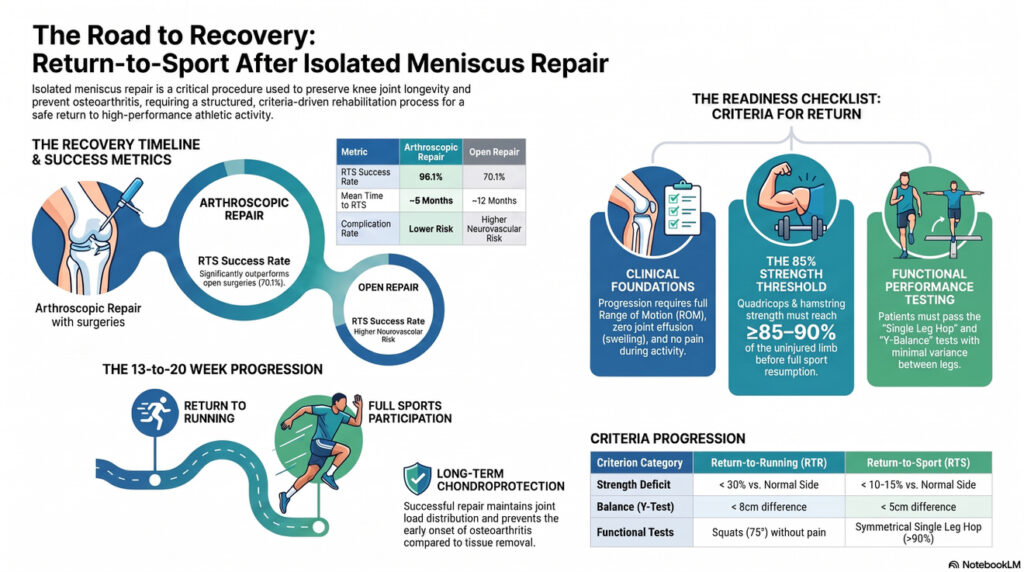
This is where a surgeon removes the torn piece of cartilage. It is the faster route. Research shows that athletes who have a meniscectomy can typically return to sport in about 7 to 9 weeks.
The trade-off? You now have less shock absorption in that knee. The remaining cartilage takes on more stress, and over time, that can accelerate wear on the joint. Faster now, but potentially harder on your knee 10 to 20 years down the road.
Option 2: Meniscus Repair (Stitching the Tear)
This is where the surgeon sews the torn tissue back together and gives it the chance to heal. It works best for tears in a specific zone of the meniscus (more on that below). The recovery is longer – usually 5 to 8 months – because you’re waiting for real tissue healing, not just rehabilitation after removal.
It is a longer road, but saving your meniscus is significantly better for long-term knee health. Athletes who have a repair protect their joint from the early arthritis risk that comes with losing that cartilage.
Which Types of Meniscus Tears Do Well Without Surgery?
Here’s what surprises a lot of athletes: not every meniscus tear needs surgery. In fact, for the right type of tear, physical therapy can work just as well as going under the knife.
The key is blood supply. The outer third of the meniscus has good blood flow – this is called the “red zone.” Tears here have a real chance of healing on their own with the right rehab. The inner two-thirds (the “white zone”) has little to no blood supply, which makes healing without surgery much more difficult.
Tears that often do well with conservative (non-surgical) treatment:
- Small, stable tears in the outer red zone
- Degenerative tears in older athletes (wear-and-tear type, not traumatic)
- Horizontal cleavage tears with minimal symptoms
- Tears with minimal swelling and no mechanical symptoms like locking or giving way
Tears that typically require surgery:
- Large, unstable tears that cause the knee to lock
- Bucket-handle tears (the cartilage folds over on itself)
- Tears in the white zone with poor blood supply
- Tears associated with an ACL injury that is also being surgically repaired
Research from Giuffrida et al. (2020) found that for degenerative tears especially, a structured exercise program with a physical therapist works just as well as surgery. This means stronger legs, less pain, and better function – without an operating room.
If your surgeon isn’t talking to you about conservative options, it’s worth asking the question.
Why Saving Your Meniscus Matters for the Long Game
I know the meniscectomy sounds appealing. Back on the field in two months? Sign me up. But there’s a cost to that shortcut that most athletes don’t find out about until they’re in their 30s or 40s with a knee that feels twice its age.
Your meniscus absorbs somewhere between 50 to 70 percent of the load across your knee joint. Remove it, and that force gets transferred directly to the cartilage covering the bones. Over time, that leads to early onset osteoarthritis.
Research from Lee et al. (2019) and Blanchard et al. (2020) consistently shows that repairing the meniscus provides significantly better long-term joint outcomes compared to removal. If you have a tear that can be repaired and you’re a young athlete with decades of sport ahead of you, that conversation is worth having with your surgeon.
The short version: if repair is an option, it’s almost always the smarter long-term play.
The Real Test Before You Return to Sport
Here’s something I tell every athlete I work with: the calendar is not your clearance.
It does not matter if it has been 10 weeks or 6 months. What matters is whether your body has actually earned the right to return to the demands of your sport. Returning too early is one of the most common reasons athletes re-injure themselves.
Before you return to running, cutting, jumping, or competing, you need to pass:
- Strength test: Your injured leg should be within about 90% of the strength of your healthy leg
- Balance and proprioception test: Single-leg balance and control should feel stable and symmetric
- Functional tests: Hop tests, agility runs, and sport-specific movements that match what your body needs to do
- Zero pain and swelling: Baseline symptoms should be resolved before return-to-sport loading
Research from Schwach et al. (2023) confirms that strength and balance criteria are far better predictors of safe return than time alone. This is exactly what we assess at In Motion Physical Therapy before clearing an athlete to return to play.
Pain going away is not the finish line. It is the starting line for return-to-sport testing.
Can You Make a Full Comeback After a Meniscus Tear?
Yes. That is the short answer, and the research backs it up.
Multiple studies, including Ekhtiari et al. (2018) and Schwach et al. (2023), show that over 80% of elite athletes return to their pre-injury level of competition after a meniscus tear — regardless of which surgical approach they chose.
A meniscus tear is not a career-ending injury. It is a manageable setback that, with the right treatment and rehabilitation, you can fully recover from. The athletes who get back to their sport at full strength are the ones who take the rehab seriously, hit the strength and balance milestones, and do not rush the process.
You have done hard things before. This is one of them. And the outcome is well within your control.
How Physical Therapy Fits Into Meniscus Tear Recovery
Whether you have surgery or not, physical therapy is the backbone of meniscus tear recovery. There is no version of this injury where you just rest and wait for it to get better on its own.
What PT looks like for a meniscus tear:
- Early phase: Reducing swelling, restoring range of motion, and rebuilding quad activation
- Strength phase: Progressive loading through the quad, hamstring, hip, and calf to protect and unload the knee joint
- Functional phase: Single-leg movements, agility, plyometrics, and sport-specific drills
- Return-to-sport testing: Objective criteria to confirm readiness before full clearance
At In Motion Physical Therapy in Farmingdale, NY, we treat meniscus injuries using hands-on manual therapy, sport-specific strength progressions, and advanced tools like blood flow restriction training — which allows us to build serious muscle strength even when you cannot fully load the joint yet. It is a game-changer for athletes in the early stages of recovery.
If you are also managing a knee injury from a sport collision or have concerns about a concurrent ACL injury, we have deep experience handling complex knee cases in athletes at every level.
Frequently Asked Questions about Meniscus Tear Recovery Time
How long does patellar tendonitis take to heal?
Can I play sports with a torn meniscus?
Do I need surgery for a meniscus tear?
When can I run after a meniscus tear?
What happens if a meniscus tear goes untreated?
The Bottom Line on Meniscus Tear Recovery Time
A meniscus tear is not a one-size-fits-all injury. Your recovery timeline depends on what type of tear you have, whether you need surgery, and how seriously you take the rehabilitation process.
The research is clear: most athletes make a full comeback. The ones who do are the ones who stop chasing the fastest timeline and start chasing the right timeline — one built on strength benchmarks, not the number of weeks since surgery.
If you are an athlete near Farmingdale, NY dealing with a meniscus tear and you want to figure out your next best step, our team at In Motion Physical Therapy can help you build a plan that gets you back to your sport and keeps your knee healthy for the long haul.
Next on Your Reading List:
-
Sore Knees After Soccer? Why "Just Resting" Isn't the Answer for Competitive Athletes
-
5 Things I Wish I Knew Before ACL Surgery: A Physical Therapist's Personal Story
-
Patellar Tendinitis Treatment: Why Rest Isn’t Working (and what actually does)
-
Blood Flow Restriction Training: How Athletes Get Stronger Without Heavy Weights
Note: This blog post provides general information and should not be considered a substitute for professional medical advice. If you have any concerns or specific conditions, consult with your healthcare provider before making changes to your recovery routine.
References:
Laura Sommer has been practicing as a Physical Therapist since 2011. She graduated from Northeastern University, where she was a member of the Women’s Soccer Team. Laura is the owner of In Motion Physical Therapy located in Farmingdale, NY.