Patellar tendonitis treatment works best when it includes progressive, structured loading — not complete rest. Research shows that tendons need controlled stress to heal and adapt. Athletes who rest completely and then return to sport often re-injure quickly because the tendon never rebuilt the strength and load tolerance it needed to handle game-speed demands.
Patellar Tendinitis Treatment
Your athlete has been sitting out. You followed the advice. Rest it. Ice it. Wait it out. And weeks — maybe months — later, nothing has changed. If anything, the knee feels worse the moment they try to get back on the court.
If that sounds familiar, you are not alone. And here is the part nobody tells you: the standard advice most families get for patellar tendonitis treatment is exactly the wrong approach. The research backs that up.
At In Motion Physical Therapy in Farmingdale, NY, we work with athletes across Long Island — volleyball players, basketball players, soccer players, and runners — and “jumper’s knee” shows up constantly. What also shows up? Families who have been waiting and resting for months and wondering why nothing is improving.
This post is going to explain why rest fails, what actually works, and what a proper patellar tendonitis treatment program looks like from start to finish.
What Is Patellar Tendinitis?
The patellar tendon connects the bottom of your kneecap to the top of your shinbone. Every time your athlete jumps, sprints, cuts, or lands, that tendon absorbs and releases a massive amount of force.
When that demand repeatedly exceeds what the tendon can handle — think volleyball tryouts ramping up after a slow summer, or a basketball player jumping twice as much during preseason — the tissue starts to break down.
This is why jumper’s knee is so common in jumping and cutting sports. Research shows that roughly 1 in 5 basketball players and about 1 in 4 volleyball players deal with patellar tendinopathy, with even higher rates in elite-level athletes.
Fall volleyball season is coming up fast. If your athlete’s knee has been bothering them all summer, now is the time to address it — not hope it resolves on its own before the first week of tryouts.
What Does Patellar Tendinitis Feel Like?
The symptoms are pretty consistent and recognizable:
- Pain just below the kneecap, usually at one specific tender spot
- Stiffness that is worst first thing in the morning or at the start of practice
- Pain that eases after warmup but flares up again after activity is over
- Symptoms that keep creeping back or getting worse over time if load is not managed
If your athlete has been describing this pattern for more than a few weeks, that is a signal the tendon needs proper treatment, not more rest.
Why Rest Alone Does Not Work for Patellar Tendinitis Treatment
Here is the part that surprises most sports parents — and honestly, a lot of coaches too.
Tendons are not like muscles. When you completely rest a muscle, it recovers. When you completely unload a patellar tendon that is already irritated and breaking down, it does not recover — it stagnates. Tendons need a reason to adapt. That reason is controlled, progressive loading.
A comprehensive review published in the Journal of Orthopaedics and Traumatology found that eccentric exercise, a specific type of strength training, consistently outperformed other conservative approaches and should be the first-line treatment for at least 12 weeks before anything more aggressive is considered. Rest alone did not make the list.
We see this play out all the time at In Motion. An athlete rests for six weeks. The pain quiets down. They head back to practice. Within a week or two, the knee is just as bad — sometimes worse. Why? Because the tendon never got stronger. It just got a break. The moment load comes back, the tissue breaks down again because nothing changed underneath.
The athletes who truly recover are the ones who build strength, pass return-to-sport testing criteria — things like hop testing and balance assessments — and work with a sports PT to gradually build back into practices before returning to full game play. Jumping straight from rest to game speed skips every step that actually matters.
The Exercise Most PTs Prescribe Too Early
Before your athlete starts any patellar tendonitis treatment program, there is something worth knowing.
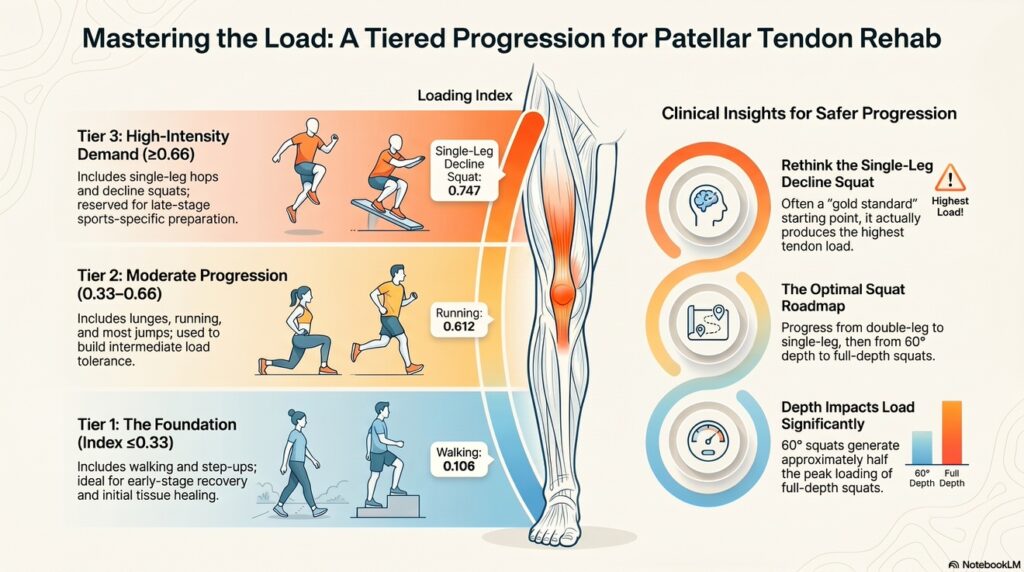
The single-leg decline squat is one of the most commonly prescribed exercises for jumper’s knee. You have probably seen videos of it. It is also — according to a 2024 study published in Medicine and Science in Sports and Exercise — the highest-load exercise out of 35 tested for the patellar tendon. It ranked higher than running. Higher than jumping. Higher than cutting drills.
Starting an already-irritated tendon on the hardest possible exercise is a common reason athletes flare up during “standard” rehab and lose confidence that physical therapy is going to help them.
The single-leg decline squat is not a bad exercise. It belongs in the program. It just belongs at the end — in the final return-to-sport phase — not at the beginning when the tendon is still fragile and reactive.
Knowing where an exercise falls in the loading progression is a skill that takes clinical experience. This is one of the reasons working with a sports physical therapist who understands tendon rehab makes a meaningful difference in outcomes.
What Effective Patellar Tendinitis Treatment Actually Looks Like
The evidence-based approach is progressive loading: start low, build systematically, and earn each jump in difficulty. Here is how we think about it in phases.
Phase 1: Building the Foundation
The goal in early rehab is simple: introduce just enough load that the tendon starts adapting, without making symptoms worse.
Exercises at this stage include:
- Walking and low-level step work
- Partial-depth double-leg squats (about 60 degrees of knee bend)
- Bodyweight movements that keep stress manageable
No single-leg work yet. No deep squats. No jumping. The tendon needs to earn the right to do those things.
Phase 2: Building Strength and Movement Capacity
This is where training starts to look more like sport preparation. It is also where a lot of programs make a critical sequencing mistake.
One important finding from the research: going from partial-depth to full-depth squats nearly doubles the load on the patellar tendon. That progression is actually a bigger jump than going from two legs to one leg at the same depth.
What that means for your athlete: a good PT should be progressing squat depth before progressing to single-leg work. Skipping that sequence is one of the most common reasons athletes stall or re-flare in the middle of a program.
Phase 2 includes:
- Single-leg squats, starting shallow and building toward full depth
- Lunges, Bulgarian squats, and sumo squats
- Running and controlled deceleration work
- Double-leg jump training with a focus on soft, controlled landings
Phase 3: Return to Sport
The final phase is about replicating the explosive, high-speed demands of your athlete’s specific sport. This is where the single-leg decline squat finally earns its place.
Phase 3 includes:
- Single-leg hop testing and repeated hop training
- Run-and-cut drills that mirror game situations
- Sport-specific activities at near-full intensity
- Gradual progression from individual workouts to practice to game play
Return to sport is not a single moment. It is a process. Athletes who rush this phase — or skip it entirely after rest — are the ones who get re-injured two weeks into the season.
Frequently Asked Questions: Patellar Tendinitis Treatment
How long does patellar tendonitis take to heal?
Should my athlete keep playing through patellar tendonitis?
Is patellar tendonitis the same as patellar tendinopathy?
Is It Time to Get Evaluated for Patellar Tendonitis Treatment?
Ready to stop the rest-and-re-injury cycle? Book an evaluation at In Motion Physical Therapy in Farmingdale, NY.
Next on Your Reading List:
Note: This blog post provides general information and should not be considered a substitute for professional medical advice. If you have any concerns or specific conditions, consult with your healthcare provider before making changes to your recovery routine.
References:
Laura Sommer has been practicing as a Physical Therapist since 2011. She graduated from Northeastern University, where she was a member of the Women’s Soccer Team. Laura is the owner of In Motion Physical Therapy located in Farmingdale, NY.