The most effective way to prevent arm injuries in baseball isn’t about icing your elbow or resting more – it’s about training your entire body from the ground up. Research shows that weaknesses in your core, hips, and ankles are the true culprits behind most throwing injuries. If you are a competitive baseball player on Long Island and you want to protect your arm and stay on the field, working with a sports physical therapist to address these full-body movement patterns is your best first step.
Surprising Ways How to Prevent Arm Injuries in Baseball
If you are a competitive high school baseball player on Long Island playing year-round club and school ball, a sudden elbow or shoulder injury is your worst nightmare. You have worked too hard to sit out during a critical showcase or lose your starting spot to someone who stayed healthier.
If you have been Googling how to prevent arm injuries in baseball, you have probably already hit the wall with the standard advice: rest, ice, and don’t throw as much. That guidance is not wrong, but it is wildly incomplete- and for a serious athlete with a full schedule of games and showcases, “just rest” is not a plan.
Here is what the latest research in sports biomechanics actually says: your arm is not the problem. It is the victim. The real risk factors for throwing injuries are hiding in your core, your hips, and even your ankles. Fix those, and your arm gets to do its job without taking on extra punishment every single game.
Here are five surprising, research-backed ways to learn how to prevent arm injuries in baseball from the ground up.
1. Lock In Your Core Balance During the Wind-Up
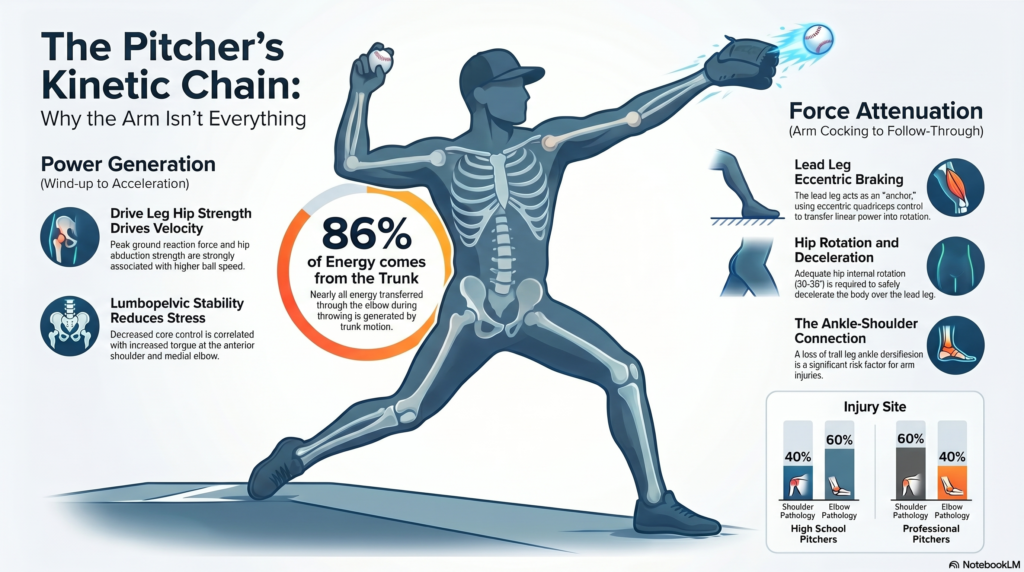
Most players assume arm injuries come from throwing too hard or too often. The research tells a different story. Pitchers who have poor single-leg balance — meaning they wobble or struggle to stay stable during the leg lift phase of their wind-up — put significantly more stress on their shoulder and elbow with every single throw.
When your core cannot hold your trunk steady on one leg, your upper body has to compensate. That compensation travels straight into your throwing arm. Training single-leg stability and core control is one of the most direct ways to reduce the load on your arm before the ball ever leaves your hand.
At In Motion Physical Therapy, we assess single-leg stability with the Y Balance Test as part of every athlete evaluation. It takes about five minutes and reveals a lot about what is actually happening in your movement mechanics — even if you have never had arm pain. It is also a cornerstone of our baseball arm care pre-season program.
2. Tap Into Back Hip Power
Think about the leg you push off the pitching rubber with. That is your engine. It is where your velocity actually comes from.
Research on pitching biomechanics is clear: pitchers with weaker hip abductors and external rotators get injured at a significantly higher rate. When your back hip is weak or not firing correctly, your arm has to make up for the lost power. It throws harder than it should to compensate for what your lower half failed to produce.
The fix is not simply “do squats.” It is targeted, sport-specific hip strength work that teaches your back leg to actually load and drive during your wind-up. When that happens, you will likely throw harder and protect your arm at the same time.
If you are already dealing with elbow pain, our full breakdown of baseball elbow pain and UCL treatment options walks through what to do next.
3. Use Your Front Leg as a Strong Brake
This one surprises a lot of players. When your stride foot lands, your front knee has one critical job: absorb your forward momentum and redirect that energy up through your trunk and into the ball.
If your front leg is weak or collapses on landing, all of that kinetic energy has nowhere to go. Instead of flowing smoothly through your body, it dumps directly into your shoulder and elbow. Pitchers with poor front leg braking mechanics show measurably higher loads on their throwing arm on every pitch.
Building front leg strength — specifically your quad and hip stability on the landing side — is not a glamorous training goal. But it is one of the most protective things a pitcher can do to reduce injury risk over the course of a long season.
4. Rotate, Don’t Lean
A lot of young pitchers try to generate more velocity by leaning or tilting their trunk aggressively toward home plate. Biomechanical research shows this is a mechanical trap: it adds almost no speed, and it dramatically increases the stress placed on the throwing arm.
Real velocity comes from trunk rotation, not lateral tilt. Research has shown that rotational power from the trunk and core contributes roughly 86% of the total energy produced in a pitch. When that rotation is replaced by side-bending, the arm has to work overtime to generate what the body failed to produce — and that is when overuse injuries happen.
If you are working on throwing harder, the answer is almost never in your arm. It is in cleaning up how your trunk rotates through the delivery.
5. Fix Your Stiff Ankles
This one catches players off guard every time. Nobody thinks about their ankles when they think about elbow pain — but they should.
Your pitching delivery is a built from the ground up. Every joint from your back foot all the way to your fingertips plays a role. When your back ankle is stiff and cannot dorsiflex (bend) properly during your wind-up, your entire push-off mechanics gets altered. Your stride shortens. Your hip drive decreases. And because the chain has to find that energy somewhere, it finds it in your throwing arm.
Research supports ankle mobility as an underappreciated risk factor for upper extremity injury in overhead athletes. Spending a few minutes on ankle mobility as part of your daily warm-up routine is a low-cost, high-return habit. A good warm-up and cool-down protocol makes a measurable difference here — see our post pitching arm care routine for exactly what to do before and after you throw.
The Full-Body Bottom Line: Preventing arm injuries in baseball is a full-body project, not just a matter of ice and rest. Your shoulder and elbow are usually the last place to feel the damage from a chain that broke down somewhere else — your ankle, your hip, your core stability on one leg. Many of the throwing injuries that sideline high school athletes every year are entirely preventable with the right movement assessment and a targeted strength program that addresses the whole chain.
And if you have been wondering should you ice your arm after pitching, we cover the current science on that question in full — the answer might surprise you.
Where to Find Your Custom Arm Protection Plan in Farmingdale, NY
Reading about how to prevent arm injuries in baseball gives you a starting point. A real movement assessment gives you an actual plan.
At In Motion Physical Therapy in Farmingdale, NY, we treat every high school competitor like the serious athlete they are. We do not hand you a generic exercise sheet or tell you to rest and come back in six weeks. We assess, we find the specific weak links in your movement chain, and we build a program around your sport, your season, and your goals.
Every session is 1-on-1 with a Doctor of Physical Therapy who is a former athlete and understands exactly what is at stake for a player with a showcase schedule and a college dream.
Here is what that looks like in practice:
Biomechanical Analysis and Movement Screens: We use the Y Balance Test and Tindeq strength testing to identify the exact weaknesses in your core, hips, and ankles that are quietly putting your arm at risk. Most athletes do not know these gaps exist until we test them.
Performance Training: We build sport-specific strength, speed, and hip drive so your lower body actually does its job — which takes the load off your arm and often adds velocity in the process.
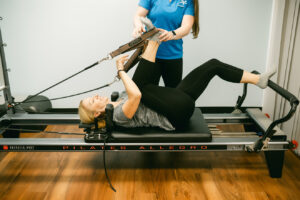
Sports-Specific Pilates: Our fully equipped Reformer studio is an advantage most PT clinics do not have. Reformer-based Pilates builds the deep core stability, single-leg control, and rotational power that your pitching mechanics depend on. Our PT-approved scapula workouts for baseball players cover the specific exercises we prescribe to keep your shoulder moving the right way all season.
Whether you play for Farmingdale High School, HHH, Plainedge, St. John the Baptist, or a Long Island travel program, you should not have to wait for a torn UCL to start taking your arm health seriously.
We proudly serve athletes from Farmingdale, Massapequa, Seaford, Wantagh, Bethpage, Plainview, Amityville, and Melville.
Free Download: The Modern Pitcher’s Arm Care Playbook
You just learned why your arm is not the problem — it is the victim. Now get the full game plan in one place.
The Modern Pitcher’s Arm Care Playbook covers the ice myth, pre-season foundation building, and the advanced recovery strategies used by elite pitchers — all in a free, easy-to-read guide built for Long Island baseball families.
Frequently Asked Questions: Preventing Arm Injuries in Baseball
What causes arm injuries in baseball pitchers?
How can a physical therapist help prevent throwing injuries?
Can I prevent UCL injuries in baseball?
What exercises help prevent arm injuries in baseball?
When should a high school baseball player see a physical therapist?
Next on Your Reading List:
-
Baseball Elbow Pain: Explore The Best Treatments
-
Baseball Arm Care: Pre-Season Training Guide for Pitchers and Players
-
Scapula Workouts for Baseball Players: Physical Therapist-Approved Exercises to Keep Your Arm Healthy All Season
-
The Ultimate Post Pitching Arm Care Routine
-
Should You Ice Your Arm After Pitching? (What the Science Actually Says)
Note: This blog post provides general information and should not be considered a substitute for professional medical advice. If you have any concerns or specific conditions, consult with your healthcare provider before making changes to your recovery routine.
References:
Chaudhari AM, McKenzie CS, Borchers JR, Best TM. Lumbopelvic control and pitching performance of professional baseball pitchers. J Strength Cond Res. 2011 Aug;25(8):2127-32. doi: 10.1519/JSC.0b013e31820f5075. PMID: 21760550. https://pubmed.ncbi.nlm.nih.gov/21760550/
Laura Sommer has been practicing as a Physical Therapist since 2011. She graduated from Northeastern University, where she was a member of the Women’s Soccer Team. Laura is the owner of In Motion Physical Therapy located in Farmingdale, NY.