Shoulder pain from softball affects pitchers and position players alike, and most injuries are muscle strains caused by repetitive throwing rather than sudden accidents. Research shows that the forces on a softball pitcher’s shoulder are comparable to those on professional baseball pitchers, making proper load management and early treatment essential. Most athletes recover within three weeks when they get the right care quickly, and a sports physical therapist can help you stay competitive while the injury heals.
→ Book a Discovery Call
Are you a softball player on Long Island? Don't settle for generic PT. At In Motion Physical Therapy in Farmingdale, NY, we specialize in getting competitive athletes back to 100%.
Your shoulder has been trying to tell you something for a few weeks now.
Maybe it’s a dull ache that shows up after practice. Maybe it flares during a hard throw and then fades. Maybe you have been quietly working around it, hoping it resolves before anyone notices.
Shoulder pain from softball is one of the most common issues I treat as a sports physical therapist. And almost every athlete who comes in says the same thing: I thought it would go away.
Sometimes it does. But when it lingers, and you have been playing through it for weeks, that minor irritation can turn into something that keeps you off the field for much longer than it had to.
Here is what you actually need to know about softball shoulder pain — what causes it, who is most at risk, and what to do about it so you can stay competitive all season long.
The Windmill Pitch Puts More Stress on Your Shoulder Than Most People Realize
A lot of players and parents assume that softball is easier on the arm than baseball. Throwing underhand feels more natural. It must be less stressful on the shoulder, right?
Research says otherwise.
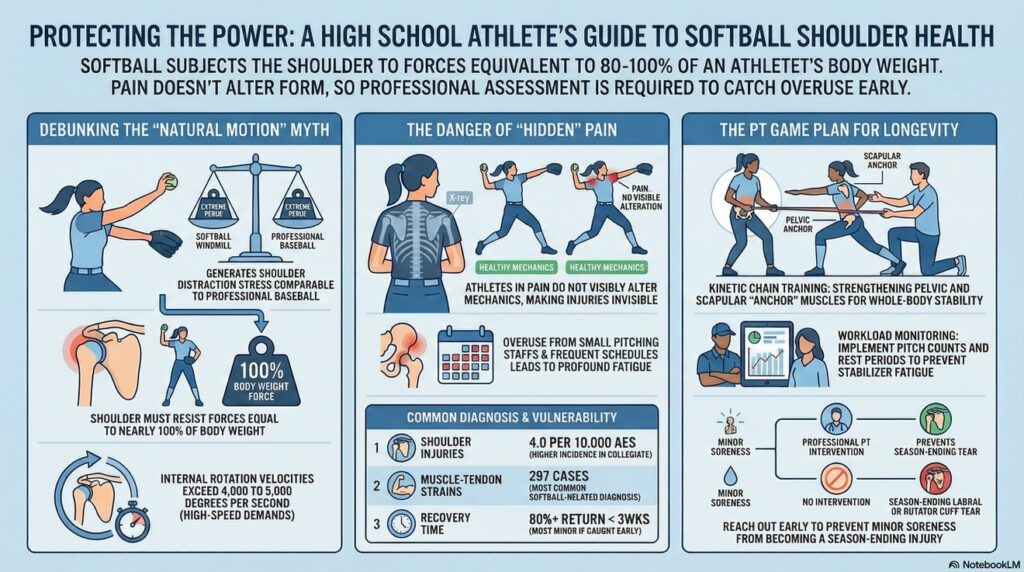
Studies have measured the forces on a softball pitcher’s shoulder during the windmill motion and found they are nearly equal to her full body weight. That is almost identical to the forces experienced by professional baseball pitchers.
Think about what that means. Every single pitch, your shoulder absorbs a load equivalent to your entire body weight. Multiply that by 100 pitches at practice, multiple practices per week, and a full competitive season. You can see very quickly why overuse injuries happen.
The windmill motion is a powerful, explosive movement. That is not a flaw — it is what makes elite pitchers so effective. But it means your shoulder deserves the same respect and maintenance that any serious throwing athlete gives theirs.
Most Softball Shoulder Injuries Are Muscle Strains, Not Serious Tears
Here is the good news: the most common softball shoulder injuries are not catastrophic.
Research shows that the majority of shoulder problems in softball players are muscle strains and overuse injuries from repetitive throwing. These injuries are painful and they slow you down, but they typically do not involve serious structural damage like ligament tears or labral injuries.
The most common culprits include:
- Rotator cuff strains — the four muscles that stabilize and move your shoulder joint
- Shoulder impingement — pinching of tendons in the joint space during arm elevation
- Biceps tendon irritation
- General muscle fatigue from throwing volume that outpaces what the body has adapted to handle
The important caveat? Minor does not mean ignore it. A muscle strain that keeps getting pushed becomes a more significant injury. Athletes who play through shoulder pain for weeks are far more likely to end up with problems that take months to resolve rather than a few weeks.
The research also shows that most softball athletes with shoulder injuries return to play within three weeks when they get the right treatment early.
Shoulder Pain From Softball Is Not Just a Pitcher Problem
This finding surprises most people.
One study of high school softball found that approximately 83 percent of shoulder injuries occurred in position players, not pitchers. Outfielders are particularly at risk. A full-effort throw from deep center field to home plate places significant force on the shoulder, and that happens repeatedly across a long season.
Infielders deal with their own version of this. The quick, high-velocity snaps involved in short infield throws add up over time, even if each individual throw feels less intense.
If you have been dismissing your shoulder pain because pitching is not your position, that reasoning does not hold up. Any player who throws hard and throws often is at risk.
You Cannot Always Tell an Athlete Is Hurt by Watching Her Throw
Coaches, parents, and players often assume that a shoulder injury will show up on the field. The mechanics will look different. The ball will come out slower. Something will seem off.
Research challenges that assumption. Studies found that softball pitchers throwing with shoulder pain maintained essentially the same mechanics as healthy pitchers. From the outside, there was often nothing to see.
This has real implications for everyone involved in the sport.
An athlete can be managing significant shoulder pain while appearing completely normal on the field. That means the only reliable way to know she is hurting is if she tells you.
It puts real responsibility on players to speak up, even in environments where playing through pain is treated as a virtue. It also puts responsibility on coaches and parents to create space where an athlete can say my shoulder is bothering me without worrying about losing her spot.
Playing through pain is not mental toughness. It is a risk factor for a more serious injury.
Practice and Early Season Are Higher-Risk Than Most Athletes Expect
Most people assume that competition is when athletes are most likely to get hurt. The pressure is higher, the intensity is greater, so the injury risk must follow.
The data tells a different story. A significant portion of softball shoulder injuries occur during practice, with the highest concentration happening at the start of the season.
The reason makes sense when you understand how overuse injuries develop. Athletes spend the off-season doing very little throwing. Then preseason arrives and they go from minimal volume to hundreds of throws per day almost immediately. The muscles, tendons, and connective tissue have not had time to adapt to that level of demand.
This is not a strength problem. It is a loading problem. The body can handle a great deal, but it needs time to build up to it.
Practical steps that help:
- Follow a structured throwing progression at the start of the season rather than jumping straight to full volume
- Take the warm-up seriously even during low-intensity or casual practices
- Pay attention to how the shoulder feels in the hours after practice, not just during it
- Communicate with coaches when arm fatigue begins to develop, before it turns into pain
What to Do When Softball Shoulder Pain Does Not Resolve on Its Own
Here is the threshold I use with athletes: if shoulder pain is affecting how you throw, how you sleep, or how you feel in the hours after practice, it deserves a professional evaluation.
You do not need to wait until the pain becomes unbearable. You do not need imaging or a physician referral before coming in. And you do not need to simply stop throwing and wait it out.
As a sports physical therapist, my approach is to keep athletes competing while we address what is actually causing the problem. That means:
- Identifying the specific structure that is irritated and the mechanical or loading factors driving it
- Building strength in the rotator cuff and shoulder blade muscles that stabilize and protect the joint
- Correcting movement patterns or muscle imbalances that are adding unnecessary stress to the shoulder
- Building a return-to-throwing plan based on your actual sport demands, not a generic timeline
The athletes I treat do not typically need surgery. They do not need to miss a full season. What they need is an accurate assessment, a targeted plan, and a provider who understands what it means to compete.
At In Motion Physical Therapy in Farmingdale, NY, we work specifically with athletes. If shoulder pain from softball is slowing you down or keeping you up at night, you do not have to push through it alone.
Learn more about our sports physical therapy services and take the first step toward getting back to full strength.
Frequently Asked Questions About Shoulder Pain From Softball
How common is shoulder pain in softball players?
Can I keep playing softball with shoulder pain?
How long does softball shoulder pain take to heal?
Do I need an MRI for softball shoulder pain?
Is the windmill pitch bad for your shoulder?
What exercises help softball shoulder pain?
Stop Guessing With Your Arm Care
If your softball player is training in Farmingdale, NY or the surrounding Long Island area, we’d love to evaluate her. At In Motion Physical Therapy, we work with competitive athletes at every level — and we know how to keep them in the sport they love while their bodies heal.
Ready to compete your best? Book your Softball Injury Evaluation at In Motion PT today →
Next on your Reading List:
-
Baseball Arm Care: Pre-Season Training Guide for Pitchers and Players
-
Should You Ice Your Arm After Pitching? (What the Science Actually Says)
-
Keep Your Arm Healthy: The Ultimate Physical Therapist’s Guide to Pitcher Shoulder Stretches
-
Scapula Workouts for Baseball Players: Physical Therapist-Approved Exercises to Keep Your Arm Healthy All Season
Note: This blog post provides general information and should not be considered a substitute for professional medical advice. If you have any concerns or specific conditions, consult with your healthcare provider before making changes to your recovery routine.
References
Werner SL, Jones DG, Guido JA Jr, Brunet ME. Kinematics and kinetics of elite windmill softball pitching. Am J Sports Med. 2006;34(4):597-603. https://pubmed.ncbi.nlm.nih.gov/16282581/
Como M, Carr JB 2nd, Brockmeier SF. Softball shoulder injuries. Sports Health. 2024;16(1):14-22. https://pubmed.ncbi.nlm.nih.gov/37365722/
Friesen KB, Barfield JW, Kagiyama Y, et al. Kinematics during fastpitch softball windmill pitching with and without pain. Sports Health. 2024;16(3):440-447. https://pubmed.ncbi.nlm.nih.gov/37431916/
Oliver GD, Gilmer GG, Anz AW. Epidemiology of injuries in high school softball players. Orthop J Sports Med. 2019;7(7). https://pubmed.ncbi.nlm.nih.gov/31367648/
- Veillard D, Gabbett TJ, Lacome M, Maurelli O. Softball pitching workloads and injury risk. J Athl Train. 2021;56(4):369-378. https://pubmed.ncbi.nlm.nih.gov/33471877/

Laura Sommer has been practicing as a Physical Therapist since 2011. She graduated from Northeastern University, where she was a member of the Women’s Soccer Team. Laura is the owner of In Motion Physical Therapy located in Farmingdale, NY.