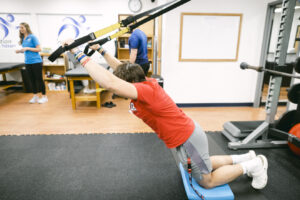
Hip flexor injuries are among the most common setbacks for lacrosse athletes, preventing you from performing at your best and potentially sidelining you from the sport you love. As a Doctor of Physical Therapy at In Motion Physical Therapy, I’ve worked with countless lacrosse players suffering from hip flexor injuries. In this post, I’ll share our proven approach to treating lacrosse hip flexor injury treatment and how our personalized plans can get you back on the field stronger than before.
What is a Hip Flexor Injury and Why Are Lacrosse Players Vulnerable?
The Anatomy in Action
Your hip flexors—especially the iliopsoas—are the muscles responsible for lifting your knee and stabilizing your pelvis. In lacrosse, these muscles fire constantly during sprints, cuts, and shots. That’s a recipe for overuse and strain, especially when muscle imbalances, poor mechanics, or fatigue set in.
Why Lacrosse Players Are Prone to Hip Flexor Injuries
Lacrosse demands rapid acceleration, direction changes, and explosive cutting—motions that heavily rely on hip flexors, especially the iliopsoas. When these muscles fire inefficiently or fatigue due to imbalance or poor warm-up, strains and tears can occur.
Hip flexor injuries occur when the muscles that help you lift your knee toward your body become strained or torn. For lacrosse players, these injuries are particularly common (incidence of 5-28% of injuries1 )due to the sport’s quick directional changes, explosive movements, and repetitive running and cutting actions.
Common Symptoms of Hip Flexor Injuries in Lacrosse Players
- Sharp pain in the front of the hip or groin area when sprinting or changing direction
- Tenderness and discomfort when lifting your knee toward your chest
- Muscle spasms in the hip or thigh region
- Swelling or bruising in severe cases
- Difficulty maintaining proper form during play
Risk Factors Specific to Lacrosse
- Muscle imbalances between hip flexors and extensors
- Inadequate warm-up routines
- Overtraining and insufficient recovery time
- Previous hip or lower body injuries
- Poor biomechanics during shooting and cutting movements
How Long Does It Take for a Hip Flexor Injury to Heal?
The recovery timeline for hip flexor injuries depends on several factors, including the severity of the injury, your individual healing capacity, and the quality of treatment you receive.
Typical Recovery Timeframes
- Grade 1 (Mild): 1-3 weeks with proper treatment
- Grade 2 (Moderate): 3-6 weeks with comprehensive rehabilitation
- Grade 3 (Severe): 6+ weeks, often requiring specialized care
At In Motion Physical Therapy, we’ve helped athletes return to competitive play faster through our personalized treatment approach. Many of our patients experience significant improvement within just a few weeks because we customize each recovery program based on individual needs and adjust treatment plans according to recovery milestones.
What Does Hip Flexor Injury Treatment Look Like?
Here’s the ugly truth about hip flexor injuries: rest alone won’t solve the problem. Effective lacrosse hip flexor injury treatment requires a comprehensive approach that addresses not just the injured tissue, but also the underlying movement patterns that contributed to the injury.
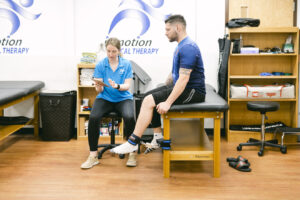
Initial Evaluation & Diagnosis: What we look for at In Motion PT
When you come to our clinic, we start by understanding your story. How did the injury happen? What activities can you do right now? What are your goals for getting back on the field?
Next, we put you through our assessment process:
- Movement screen (SFMA) to identify any dysfunctions that contributed to your injury
- Range of motion and strength measurements using our Tindeq system for precise data
- Functional movement testing like squats, step-ups, and sport-specific movements
Here’s what makes us different: we don’t just look at your hip flexor in isolation. We examine how your entire body moves as an integrated system. This approach helps us identify the root cause of your injury, not just treat the symptoms.
This comprehensive evaluation allows us to create a personalized treatment plan that’s tailored specifically to you, your sport, and your goals.
In Motion Physical Therapy’s 3-Phase Treatment Approach
Injury recovery is organized into three phases: acute management, strengthening, and return-to-sport.
Phase 1: Acute Treatment (First Few Sessions)
Goal: Reduce pain and protect the injured area while maintaining fitness
During the first few visits, we focus on:
- Pain management through manual therapy, ice, and compression
- Gentle mobility work including breathing techniques and light stretches
- Safe movement patterns to prevent compensation and protect your healing tissue
- Low-impact exercises to maintain your cardiovascular fitness
Phase 2: Progressive Rehabilitation (Strengthening)
Goal: Rebuild strength, stability, and proper movement patterns
As pain decreases, we shift focus to:
- Manual therapy and soft tissue work to improve tissue quality and mobility
- Targeted strengthening for your glutes, core, and hip flexors to address muscle imbalances
- Pilates-based exercises to enhance core stability and hip control
- Full kinetic chain training to ensure your entire body works together efficiently
Phase 3: Return-to-Sport Protocol (Final Phase)
Goal: Return to competitive lacrosse with confidence and enhanced performance
In the final phase, we prepare you for game-ready performance:
- Progressive sprint drills that gradually increase speed and intensity
- Agility training focused on cutting, dodging, and directional changes
- Lacrosse-specific movements including shooting mechanics and defensive positioning
- Reactive training to simulate game situations and build confidence
3 Essential PT Exercises for Hip Flexor Injury Recovery
Here are three exercises I consistently recommend for hip flexor recovery:
1. Prone Quad Stretch in Lumbar Locked Position
Why it works: Directly targets tight hip flexors while maintaining proper pelvic position
How to perform it correctly:
- Lay on your stomach on an elevated surface
- Place one foot on the floor in front of you
- Pull other heel towards your bottom to feel a stretch in your quad and hip flexor
Pro tip: Focus on breathing and relaxation to maximize the stretch
2. Single-Leg Glute Bridges with Marches
Why it works: Strengthens the posterior chain to balance hip flexor dominance
How to perform it correctly:
- Lay flat on your back with both knees bent
- Lift one knee towards your chest
- Lift both hips up off the ground (using 1 leg)
- While hips are lifted, place the foot down and switch the knee lifted
- Switch feet back, and slowly lower (using 1 leg)
- Repeat 10x (each leg leading)
Common mistake to avoid: Don’t let your lower back arch during the movement
3. Straight Leg Raises with Iso Holds @ 30*/60*
Why it works: Safely rebuilds strength in the injured muscle without overstressing it
How to perform it correctly:
- Lay flat on your back
- One knee bent, lift the other leg up off the ground 30 degrees hip flexion. Hold 10 seconds, slowly lower. Repeat 10x
- Same as above, lift leg to 60* hip flexion
3 Return to Sport Exercises for Hip Flexor Injury
- Resisted Lateral Shuffles
- Why it works: Recreates defensive movements specific to lacrosse while building hip stability
- How to progress: Increase speed and resistance as control improves
- Single-Leg Rotational Medicine Ball Throws
- Why it works: Integrates core rotation with hip stability, mimicking shooting mechanics
- Focus point: Maintain hip stability while generating power through the core
- Deceleration Training with Cutting Pattern
- Why it works: Many hip flexor injuries occur during rapid deceleration or direction changes
- Training cue: “Soft landings” with proper hip-knee-ankle alignment
Lacrosse Hip Flexor Injury Treatment FAQ
Get answers to the most common questions we hear from lacrosse players dealing with hip flexor injuries.
What should I avoid when I have a hip flexor injury?
Immediately after a hip flexor injury, avoid activities that cause sharp pain, particularly explosive movements like sprinting and cutting. Low-impact cross-training can be beneficial for maintaining fitness while healing, but avoid stretching into pain or returning to play too soon, which can extend your recovery time by weeks or even months.
Can I still play lacrosse with a mild hip flexor strain?
While some athletes continue playing with mild strains, doing so significantly increases your risk of developing a more severe injury that could sideline you for an entire season. At In Motion Physical Therapy, we’ve found that addressing injuries properly the first time leads to more sustainable athletic careers and fewer recurring problems.
How can I prevent hip flexor injuries from recurring?
The key to preventing recurrent hip flexor injuries lies in addressing the muscle imbalances and movement patterns that contributed to the initial injury. Our maintenance programs include regular hip mobility work, proper warm-up routines, periodized training plans to prevent overtraining, and regular screening for early signs of trouble.
Your Path Back to the Field Starts Here
As a former collegiate athlete, I understand how frustrating hip flexor injuries can be—and how important it is to get back to the sport you love quickly and safely. Our approach at In Motion Physical Therapy combines expert knowledge with personalized care to help you not just recover, but come back stronger than before.
If you’re dealing with a hip flexor injury and you’re located near Farmingdale, NY, we would love to help you at In Motion Physical Therapy. With convenient hours (open 11AM-9PM during the week and 8AM-1PM Saturdays) and 30-minute sessions available, we make it easy to fit recovery into your busy training schedule.
References:
- Christopher ZK, Hassebrock JD, Anastasi MB, Economopoulos KJ. Hip Flexor Injuries in the Athlete. Clin Sports Med. 2021 Apr;40(2):301-310. doi: 10.1016/j.csm.2020.11.006. Epub 2021 Jan 19. PMID: 33673888.
- Hammond KE, Kneer L, Cicinelli P. Rehabilitation of Soft Tissue Injuries of the Hip and Pelvis. Clin Sports Med. 2021 Apr;40(2):409-428. doi: 10.1016/j.csm.2021.01.002. Epub 2021 Feb 10. PMID: 33673896.
- Juan J, Leff G, Kevorken K, Jeanfavre M. Hip Flexor Muscle Activation During Common Rehabilitation and Strength Exercises. J Clin Med. 2024 Nov 4;13(21):6617. doi: 10.3390/jcm13216617. PMID: 39518756; PMCID: PMC11546833.

Laura Sommer has been practicing as a Physical Therapist since 2011. She graduated from Northeastern University, where she was a member of the Women’s Soccer Team. Laura is the owner of In Motion Physical Therapy located in Farmingdale, NY.